
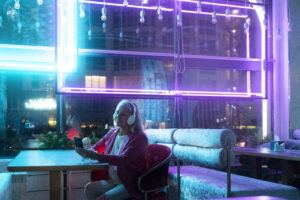
A Nightclub Without the Physical World
A nightclub is usually a place full of noise, bodies, and movement. Loud music, flashing lights, people standing too close to each other, trying to be seen without looking like they are trying. Now remove the physical space completely. No real bodies, no shared air, no actual crowd. What remains when a nightclub exists only inside a headset?
That question sounds strange until you actually step inside one.
When a Virtual Space Stops Feeling Like a Game
When a reporter entered a virtual nightclub using VR, the experience did not feel like a game or a simulation. It felt social. People talked, danced, and watched one another. The difference was that none of them were physically there. Each person existed through an avatar, shaped not by biology but by choice. And that changes everything.
Identity Becomes Something You Can Choose
In a virtual nightclub, identity becomes flexible. You can appear taller, smaller, older, younger, human or not. You can exaggerate who you are or hide parts of yourself completely. For some people, this freedom feels playful. For others, it feels deeply personal. The nightclub becomes less about music and more about expression.
How Social Behaviour Forms Almost Instantly
What stood out most was how quickly people adapted. Within minutes, normal social behaviours appeared. People formed small groups. Some stayed quiet on the edges, while others moved confidently into the centre. Just like in a real club, not everyone wanted attention, but everyone wanted to belong somewhere.
This is where virtual reality becomes interesting—not as technology, but as a mirror.
Spaces That Quietly Control Interaction
Guided by VR researcher and club organiser Karl Clarke, the visit revealed that these spaces are not random or chaotic. They are carefully designed environments where movement, sound, distance, and visibility all influence how people interact. Even in a virtual room, personal space still matters. Stand too close to someone’s avatar and discomfort appears. Stay too far away and conversation becomes awkward.
The body may be digital, but social instincts remain very real.

Why Emotions Feel Real Even When the World Isn’t
What surprised researchers is how emotionally invested people become. Conversations feel meaningful. Awkward silences feel awkward. Rejection still stings. The brain responds as if the interaction matters, because to the person experiencing it, it does.
Studying Social Presence Through Virtual Bodies
This is why VR researchers are increasingly interested in social presence. In some experiments, every aspect of a participant’s virtual identity is manipulated—height, voice tone, eye contact, reaction time. Even small changes can shift how others respond. A slightly taller avatar may be taken more seriously. A delayed response may be read as disinterest. These reactions happen automatically, without conscious thought.
In other words, we bring real-world biases into virtual spaces, even when the world itself is imaginary.
How Safety Changes the Way People Act
Virtual nightclubs also reveal something else: safety changes behaviour. Many users report feeling more relaxed in VR than in real nightlife settings. There is no risk of physical harm. No one can touch you. You can leave instantly. This sense of control allows some people to be more open, more confident, and more expressive than they would ever be offline.
When Anonymity Becomes a Shield
For others, the anonymity offers protection. Shy people speak more. Those who feel judged in physical spaces experiment with identity. The nightclub becomes a place where social rules still exist, but consequences feel softer.
Imperfect Spaces That Still Matter
This does not mean virtual spaces are perfect. Harassment still happens. Power dynamics still form. But the way people respond to them can be studied, adjusted, and redesigned. That is part of why these environments are valuable to researchers.
Beyond Nightclubs and Entertainment
Beyond nightlife, the same principles are already being applied elsewhere. Film studios use VR to plan scenes and camera movement. The military uses it for training under controlled stress. Therapists use it for rehabilitation and exposure therapy. AI researchers use it to observe human reactions in simulated social settings.
Why a Nightclub Is the Right Place to Observe Humans
The nightclub may seem like an unusual entry point, but it makes sense. Social behaviour is most visible when people gather for pleasure rather than purpose. In a club, no one is there to complete a task. They are there to exist among others.
Interaction Without Physical Reality
What these virtual spaces show is that human interaction does not depend on physical reality as much as we assume. Presence, attention, and response matter more than walls or floors. When those elements are convincing, the experience becomes real enough.
Why Ready Player One No Longer Feels Like Fiction
The reference to Ready Player One feels less dramatic after seeing this firsthand. Not because we are close to living inside virtual worlds permanently, but because the emotional foundation is already there. People care about what happens in these spaces. They remembered conversations, formed impressions, and returned.

What a Virtual Nightclub Ultimately Reveals
A virtual nightclub is not about escaping reality. It is about revealing it. It strips interaction down to its core: how we see ourselves, how we want to be seen, and how others respond when given only fragments of who we are.
In that sense, the question is no longer whether virtual social spaces are real. The question is how much of our humanity we carry with us when we enter them.