
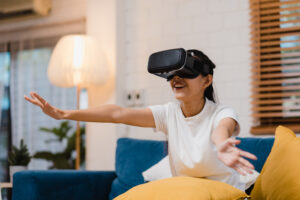
When Virtual Reality Stops You From Seeing the Real World
Virtual reality is designed to do one thing extremely well: take your attention away from everything else. The moment a headset goes on, the physical world fades. Desks disappear, people nearby become invisible, and even simple sounds lose their meaning — you are somewhere else. This is exactly what makes VR powerful — and also what makes it problematic.
As VR slowly enters workplaces, laboratories, and design studios, a new question is emerging. What happens to the real world while someone is fully immersed in a virtual one? Conversations are missed, and gestures go unseen. Small but important events vanish the moment they happen.
Researchers are now trying to solve that problem, not by pulling people out of VR, but by helping them reconnect later.
The Problem No One Notices at First
In a traditional office, awareness is shared. You can see when someone is busy, wait your turn, and interrupt carefully. VR breaks that unspoken social system.
When someone is wearing a headset, they look present but are functionally absent. You can’t tell if they noticed you or whether your words reached them. Even waving a hand in front of their face does nothing.
This creates a new kind of social gap — not distance, but overlap without awareness. As VR becomes more common for focused work, collaboration, and training, that gap becomes harder to ignore.
Recording Reality Instead of Interrupting It
One proposed solution flips the problem around. Instead of forcing communication to happen in real time, why not let reality wait?
The idea is simple: while a person is immersed in VR, their immediate physical environment is quietly recorded. Not as flat video, but as spatial data — movement, position, timing. Later, once the headset comes off, the user can replay what happened around them as a three-dimensional reconstruction.
It works less like surveillance and more like an answering machine for the physical world. Someone walked in and tried to speak. Someone waited, then left. All of it can be reviewed afterward, without breaking concentration in the moment.
Why This Feels Different From Normal Recording
This is not the same as checking security footage or watching a missed video call. A 3D reconstruction preserves context. Where a person stood. How close they were. Whether they hesitated or rushed. These details matter socially, even if we rarely think about them.
By replaying events in space rather than on a screen, the experience becomes more intuitive. You don’t just see that someone came by — you feel how the moment unfolded. That difference may seem subtle, but it changes how missed interactions are understood.
A New Kind of Workplace Awareness
In future workplaces, VR users may spend hours inside simulated environments. Designers might build virtual prototypes. Engineers might test systems. Analysts might visualize complex data.
Pulling someone out of VR every time something happens around them defeats the purpose of immersion. Ignoring the real world entirely creates isolation.
Recording and replaying reality offers a middle ground. It allows people to remain focused without becoming unreachable. Communication becomes asynchronous, but still human.
Social Consequences We Haven’t Fully Considered
There is something quietly unsettling about the idea of replaying real-world interactions after they have passed. Social moments usually exist only once. Recording them changes their nature. Knowing that your presence will be reviewed later may alter how people behave. Some may feel more cautious. Others may feel ignored in new ways.
This technology does not remove social tension — it reshapes it. Researchers are increasingly aware that the hardest problems here are not technical. They are emotional. Trust, consent, and expectation all matter more than resolution or accuracy.
Beyond Offices and Productivity
The implications extend far beyond work. In training environments, missed warnings or instructions could be reviewed safely. In medical settings, staff could replay events without interrupting critical procedures. In education, students immersed in VR could later understand what they overlooked.
For people with hearing or mobility limitations, spatial replay could offer clarity that real-time interaction sometimes lacks. In each case, the goal is not constant awareness, but recoverable awareness.
When Reality Becomes Flexible
Virtual reality has always been about constructing worlds. This shift is about reconstructing the one we already live in.
By allowing reality to be paused, stored, and revisited, VR quietly changes our relationship with time and attention. Being unavailable no longer means being disconnected. Missing something no longer means losing it forever.
That may sound convenient. It may also change how responsibility is felt. If everything can be replayed, what does it mean to miss a moment?
The Real Question Behind the Technology
This technology is often described as a tool. In truth, it is an experiment. It tests how much of human interaction depends on immediacy. It asks whether presence must be shared in the same moment, or whether understanding can arrive later and still feel real.
Virtual reality is no longer just isolating users from the world. It is beginning to negotiate with it. And in doing so, it forces us to reconsider something basic: whether being present is about where we are — or when we choose to notice.