
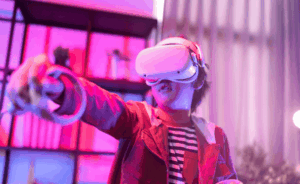
The Screen Is Becoming a room, and the Room Is Becoming the entertainment
Entertainment technology has a consistent and well-documented pattern of evolution. Each generation of entertainment technology was initially dismissed as a niche product for enthusiasts, encountered the legitimate practical limitations of its early form, gradually solved those limitations through iteration and investment, and eventually became so integrated into everyday cultural life that its absence became difficult to imagine.
Radio seemed like an enthusiast’s toy until it became the household communication and entertainment medium of an entire generation. Television seemed like an expensive novelty until it became the dominant cultural medium of the twentieth century. Streaming video seemed like a supplementary service for tech adopters until it replaced conventional broadcast television as the primary viewing format for most of the world’s internet-connected population.
Virtual reality entertainment is at the stage that each of these technologies occupied before the transition to mainstream dominance—genuinely impressive in its best implementations, limited in its current form by hardware constraints and content gaps, and consistently underestimated by observers who mistake its current limitations for its eventual ceiling.
The transition from screen-based entertainment to immersive environment-based entertainment is not a speculative possibility. It is an ongoing reality that is moving faster than most entertainment industry observers predicted. Understanding what VR entertainment actually offers — and what genuine challenges stand between its current state and its eventual mainstream position — is the conversation worth having now rather than after the transition has occurred.
What Immersive Entertainment Actually Delivers That Screens Cannot
The fundamental difference between screen-based entertainment and VR entertainment is not one of quality or resolution — it is one of presence.
A screen presents content that the viewer observes from outside. A VR environment places the viewer inside the content. This distinction sounds simple and it produces differences in the entertainment experience that are profound and immediately felt by anyone who has spent meaningful time in genuinely good VR entertainment content.
Scale is the most immediately impressive quality—the sense of genuine size and spatial relationship that flat screens cannot replicate. The concert stadium that fills the actual visual field. The natural landscape that extends to the genuine horizon. The cinematic scene that occupies genuine three-dimensional space rather than a rectangular frame.
Presence is the most experientially significant quality — the sense of genuinely being somewhere rather than watching a representation of somewhere. This presence quality is what activates the emotional engagement that makes entertainment genuinely involving rather than merely stimulating. The viewer who is present in a dramatic scene rather than watching it responds emotionally in a fundamentally different way—the investment is deeper, the impact is more durable, and the memory of the experience is qualitatively different from screen-based entertainment memory.
Live Content and the Death of the Spectator Position
One of the most compelling and most commercially significant applications of VR entertainment is the transformation of live content consumption—the experiences that have always been most valuable when attended in person but that the majority of the audience has always accessed from the spectator position of television broadcasts.
Sport is the most obvious and most commercially significant category. The experience of watching a cricket match from a seat in the stadium — the actual scale of the playing field, the ambient crowd energy, the genuine spatial relationship between the viewer and the action — is categorically different from watching the same match on a television screen. The television broadcast is an excellent representation of the match. The stadium experience is the match.
VR live sport content, at its best implementations, begins to close this gap in ways that no television broadcast technology has managed. The viewer is present in a virtual version of the stadium — not watching a camera feed of the stadium — and the experience that results is genuinely closer to attendance than any previous broadcast format.
The same principle applies across live entertainment categories—concerts, theatrical performances, cultural events, and news coverage of significant events—wherever the value of the experience is substantially greater in physical attendance than in broadcast reception; VR creates a middle ground that is substantially more valuable than conventional broadcast.
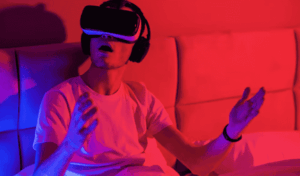
Personalization—The Entertainment Experience Built Around You
The personalization capability of VR entertainment is qualitatively different from the personalization that content recommendation algorithms provide on streaming platforms.
Streaming personalization customizes what content is offered. VR personalization extends to the environment in which all content is experienced—the virtual space that the viewer inhabits while watching, the ambience that surrounds the content, and the spatial and atmospheric qualities that frame the entertainment experience.
The viewer who watches a film in a virtual home cinema they have designed to their specific preferences—the screen size, the room aesthetic, and the ambient atmosphere—is having a different experiential relationship with the content than the viewer watching the same film on a standard television. The environment that surrounds content affects how that content is experienced, and VR provides control over that environment that physical reality cannot offer.
The potential for personalization to extend into content itself—the narrative experiences that adapt to viewer choices and viewing patterns, the live events that offer multiple simultaneous viewpoint options—represents the longer-term personalization frontier that VR entertainment technology makes technically possible.
Social Entertainment in the Age of Physical Distance
The social dimension of entertainment — watching together, sharing reactions, the collective experience of a cultural moment — is one of the genuine losses of the streaming era. Television brought families and communities together around shared viewing experiences that streaming’s individual device consumption has fragmented.
VR entertainment creates a new form of shared viewing experience that is potentially richer than the television-era social viewing it replaces. Virtual spaces where friends or family members in different physical locations share a VR viewing environment—genuinely present together in the virtual space, able to interact naturally, watching content together with the genuine social quality of co-presence—recreate the social dimension of entertainment in a format that physical distance cannot prevent.
For the genuinely global families and friend groups that characterize modern social life—where meaningful relationships are distributed across cities and countries—VR social entertainment provides a quality of shared experience that no previous technology has managed at the same level.
The Honest Assessment of Current Limitations
The enthusiasm for VR entertainment’s potential must be grounded in an honest assessment of the limitations that currently prevent it from fulfilling that potential at a mainstream scale.
Hardware comfort for extended viewing remains a genuine issue. The headset weight and the visual fatigue that current display technology creates during viewing sessions longer than sixty to ninety minutes are real constraints on the entertainment consumption patterns—multi-hour film viewing and long-form television consumption—that mainstream entertainment involves.
Content availability is the most significant current limitation. The quantity of genuinely high-quality VR-native entertainment content is insufficient to sustain the continuous consumption that mainstream entertainment platforms deliver. The technology can deliver the experience. The content library to fill the experience with daily entertainment choices does not yet exist at the scale mainstream adoption requires.
Battery life and the physical cable or device management that current hardware requires are practical friction points that make spontaneous casual viewing—the primary mode of mainstream entertainment consumption—less accessible than screen-based alternatives.
These limitations are genuine, and each has a development trajectory toward resolution. The question is not whether they will be resolved but how quickly.
The screen has been the dominant entertainment medium for eighty years because it was the best available mechanism for bringing compelling visual content into the experience of viewers who could not physically attend its production. VR is the first technology that genuinely improves on the screen’s fundamental offer — not by making the screen bigger or sharper but by replacing the screen with an environment.
When the content library catches up with the technology capability and when the hardware achieves the comfort and accessibility of the devices it will eventually replace, VR will occupy the position in entertainment that every previous generation of entertainment technology has eventually occupied.