

The Design Decision Made With Complete Confidence Because You Walked Through It First
Interior design has always been a business built on imagination — the client’s imagination of what the finished space will look and feel like, the designer’s imagination of how the proposed design will actually exist in the real space, and the often-painful collision between these two imaginations when the finished space reveals that they were not, in fact, the same imagination.
The client approved a color scheme from swatches that looks different on the finished walls. The furniture arrangement that worked in the floor plan but feels wrong in the actual room. The lighting design that achieved its intended effect in the designer’s visualization but not in the built space with the actual natural light conditions of the actual building.
These misalignments between design proposal and design reality are not failures of skill or failures of communication. They are the predictable consequence of asking non-specialists to accurately imagine three-dimensional spatial experiences from two-dimensional representations—which is what every design presentation format that precedes VRAshwa’s solution has asked clients to do.
VRAshwa’s VR interior design solution eliminates this requirement completely. Clients do not imagine the finished space. They walk through it.
What VR Walkthrough Changes About Interior Design Consultation
The transformation that VRAshwa’s VR solution brings to interior design consultation is the elimination of the representation gap—the gap between what the design shows and what the client imagines the design shows.
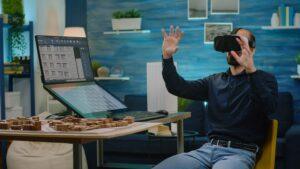
The client who puts on a VR headset and walks through a virtual version of their space, furnished and finished according to the proposed design, experiences the proposed design rather than a representation of it. The scale of the room is real because it corresponds to the client’s actual body scale. The color of the walls is experienced in the actual light conditions of the actual space because the VR model incorporates the real spatial dimensions and real window positions of the actual building. The furniture arrangement is evaluated from the perspective of actually being in the room rather than looking at a floor plan.
This is not a visualization improvement over conventional 3D rendering. It is a qualitative change in what the client is doing during the design review — from evaluating a representation to experiencing a proposal.
The practical consequence of this change is consistently reported by interior designers who have adopted VRAshwa’s VR solution—the client decisions made after VR walkthroughs are more confident, more definitive, and more stable than decisions made after conventional presentations. The revision cycles that consume significant design fees and project time are substantially reduced because the client who has walked through the design understands it accurately rather than imagining it approximately.
Specific Applications Across Interior Design Sectors
The value of VRAshwa’s VR interior design solution varies somewhat by sector, and understanding where it creates the most distinctive value helps interior design professionals prioritize their VR capability investment.
Residential interior design — particularly the high-value residential projects where client investment is significant and design ambition is high — creates the clearest case for VR walkthrough capability. The residential client making a significant investment in their home environment has the most to gain from complete confidence in the design before implementation begins and the most to lose from discovering misalignments after construction or renovation work is complete.
Commercial interior design—office fit-outs, retail environments, and hospitality spaces—creates a specific VR value in stakeholder alignment. Commercial design projects typically involve multiple decision-makers whose spatial imagination of the proposed design differs in ways that create disagreement and revision cycles during conventional presentation. The VR walkthrough creates a shared experience rather than a shared representation—the stakeholders who have walked through the same virtual space are aligning on the same experience rather than on different imaginations of the same 2D presentation.
The developer and real estate sales application—using VRAshwa’s VR solution to sell apartments and houses at the concept or construction stage—is the application where VR visualization has the most direct commercial return. Buyers who can experience a virtual version of the apartment they are purchasing from plans have the confidence to commit, which a plan-based presentation alone rarely creates.
The VRAshwa Platform for Interior Design Professionals
VRAshwa’s interior design The VR platform is designed for interior design professionals rather than for VR specialists—the workflow integration, the model import capabilities, and the presentation infrastructure are built around how interior designers actually work rather than around the technical requirements of VR production.
The ability to import models from the design software that interior designers use—the SketchUp models, the AutoCAD files, and the Revit models that represent the standard professional tools of the sector—and to present them in VR without requiring specialist VR development work is the specific capability that makes VRAshwa’s platform practically accessible to the full range of interior design professionals rather than only those with the resources to commission custom VR development.
The presentation interface that VRAshwa’s platform provides for client walkthroughs is designed for the client experience—intuitive, comfortable, guided by the designer rather than requiring clients to navigate independently, and creating the best possible first experience for clients who may be using VR for the first time.
The best interior design decisions are the ones made with complete spatial understanding of what is being decided. VRAshwa’s VR solution provides that understanding by putting clients inside the proposed design before the first material is ordered or the first wall is painted.
The design that is right is confirmed. The design that is wrong is revised before the cost of being wrong is incurred.
That is not a technology benefit. That is a business model improvement — for the designer whose revision costs decrease and whose client satisfaction increases, and for the client whose investment produces the space they actually wanted.
VRAshwa makes this possible. The interior design industry in India is discovering, practice by practice, that it changes everything about how client confidence and design quality are built.