
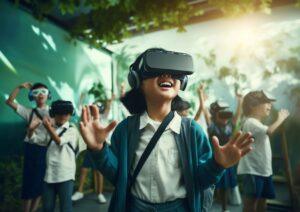
One of Australia’s Largest Supermarket Chains Has Found a Use for VR That Most People Would Never Have Predicted—and the Results Are Genuinely Impressive
When most people think about virtual reality in a retail context, their minds go to the consumer-facing applications—the virtual try-on, the immersive product demonstration, the augmented reality shopping experience that makes the purchase decision more engaging and more confident.
What they almost certainly do not think about is avocados.
And yet Woolworths—one of Australia’s largest and most operationally sophisticated supermarket chains—has deployed VR headsets for training employees in the specific and genuinely complex world of avocado supply chain management. The decision is more interesting than it initially sounds, and the reasoning behind it reveals something important about where immersive training technology is heading across every sector that deals with perishable goods, quality management, and the kind of tacit knowledge that has historically been the most difficult type to transfer between experienced practitioners and new employees.
The Avocado Supply Chain Problem That VR Is Solving
To understand why Woolworths chose VR for avocado supply chain training, it helps to understand what makes avocado supply chain management genuinely difficult.
Avocados are among the most technically demanding produce items that supermarket chains manage. The ripening process is rapid and non-linear—an avocado that is correctly firm for transport can move through the complete ripening cycle in a matter of days, and the window between ideal ripeness for sale and overripeness that renders the product unsellable is measured in hours rather than days at the consumer end of the chain.
Managing this ripening process correctly across the complete supply chain—from the grower assessment of harvest readiness, through the temperature-controlled transport conditions that determine ripening rate through the distribution center handling that either preserves or compromises ripeness management, or through the store-level display management that presents avocados in the correct ripeness state to consumers—requires a level of tacit knowledge about fruit condition assessment that takes experienced practitioners years to develop.
The experienced produce manager who can assess avocado ripeness correctly by touch and visual inspection, who can identify the specific skin texture and color signatures that indicate the precise position in the ripening curve, and who can make the correct decisions about display rotation and temperature adjustment based on current conditions—this person carries knowledge that is genuinely difficult to teach through conventional training methods.
Written procedures cannot convey the tactile and visual subtlety of ripeness assessment. Classroom instruction without the actual fruit cannot build the sensory recognition skills that correct assessment requires. Even on-the-job training with actual avocados is limited by the availability of experienced practitioners to provide consistent guidance and the pace at which the training environment naturally presents the full range of conditions and problems that real supply chain management involves.
How VR Addresses the Tacit Knowledge Transfer Problem
VR training for avocado supply chain management addresses the tacit knowledge transfer problem through a specific combination of capabilities that conventional training methods cannot replicate.
The visual simulation of avocado condition across the complete ripening spectrum—from the firm, dark green of correctly harvested fruit through the progressive color and texture changes that mark the ripening stages to the overripe condition that indicates unsellable product—creates the visual training library that allows employees to develop recognition skills before they encounter the real conditions in the supply chain.
The ability to present this complete spectrum in a controlled training environment, at any point in the ripening curve, in any quantity, with consistent expert annotation of what each visual and tactile signal indicates—creates the learning density that on-the-job training cannot match. The trainee who has completed a VR training session on avocado ripeness assessment has encountered more examples, in more controlled conditions, with more consistent expert guidance than weeks of conventional on-the-job training typically provides.
The scenario-based training that VR enables — the simulated supply chain decision point where the trainee must assess a delivery of avocados and make the correct temperature and display decisions based on their condition — creates the decision-making practice that builds genuine competency rather than theoretical knowledge. The trainee who has made the correct and incorrect decisions in simulation, seen the consequences of each choice play out in the virtual environment, and received feedback on their reasoning is significantly more prepared for the real decision than the trainee whose preparation was entirely theoretical.
The Broader Implications for Retail Training
Woolworths’ VR avocado training is not an isolated innovation. It is a leading example of a broader shift in how sophisticated retail organizations are thinking about the training challenges that their operational complexity creates.
The produce department of a large supermarket chain is a genuinely complex operational environment—the temperature management, the quality assessment, the display management, the rotation discipline, and the supplier relationship management that keeping fresh produce in optimal condition requires involve a level of operational skill that the retail industry has historically struggled to train consistently at scale.
VR training addresses the scale challenge specifically. The training program that requires experienced produce managers to personally guide every new employee through the tacit knowledge of quality assessment cannot scale to the hundreds of new employees that a large retail chain onboards annually. The VR training program that encodes this tacit knowledge in a consistent, scalable, assessable format can be deployed to every new employee simultaneously without the constraint of experienced practitioner availability.
The consistency advantage compounds the scale advantage. The VR training that every employee receives is identical in content and quality — not dependent on the teaching skill, the availability, or the current workload of the experienced practitioner who would otherwise be delivering it. This consistency creates the uniform baseline competency that large retail organizations need to deliver consistent quality across hundreds of locations.
Why This Story Matters Beyond Retail
The Woolworths VR avocado training story matters beyond the retail sector because it demonstrates something important about where VR training is most genuinely valuable—and this has implications for every sector that deals with tacit knowledge, quality assessment, and the kind of operational skill that conventional training methods have always struggled to transfer efficiently.
Food manufacturing, pharmaceutical production, healthcare diagnostics, agricultural management, and construction quality control—all of these sectors contain bodies of tacit knowledge that experienced practitioners carry and that organizations have historically transferred through the slow, expensive, inconsistent process of apprenticeship-style on-the-job training.
VR training creates the possibility of encoding this tacit knowledge in a format that is scalable, consistent, assessable, and available to every new employee simultaneously. The Woolworths avocado example is the retail proof of concept for this broader possibility—and the organizations that understand its implications earliest will build the training infrastructure that delivers the consistent operational quality that their markets increasingly demand.
Nobody expected avocados to be the use case that illustrated VR training’s genuine operational value most clearly. But the specific challenge of avocado supply chain management—the tacit knowledge, the sensory assessment skills, and the decision-making under uncertainty—turned out to be exactly the kind of training challenge that VR addresses most powerfully.
The most important VR training stories are not always the most dramatic ones. Sometimes they are about avocados.