
The University That Prepares Students for a World It Has Not Fully Entered
Industry 4.0 is not a future scenario. It is the operational reality of the industries that university graduates are entering right now, this year, in their first professional roles—the factories where cyber-physical systems monitor and adjust production in real time; the supply chains where AI-driven logistics systems make autonomous routing decisions; the design processes where digital twins simulate product performance before physical prototypes exist; and the financial systems where machine learning algorithms process transactions at speeds and volumes that human oversight cannot follow.
The students who are graduating into this environment were educated, in most cases, by universities whose own operations, research frameworks, and pedagogical approaches were developed for the industrial world that preceded it. Not because universities are indifferent to industrial change—most are genuinely trying to adapt—but because the speed and depth of the Industry 4.0 transformation is occurring faster than traditional educational institutions can track and respond to through internal curriculum development processes alone.
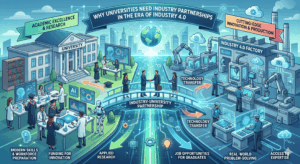
Industry partnerships are not a supplement to this adaptation process. They are the mechanism through which genuinely current Industry 4.0 capability enters university education—the channel through which the operational reality of cyber-physical systems, artificial intelligence, advanced robotics, and digital integration reaches students before they graduate rather than after they arrive in industries where their education did not prepare them for what they found.
What Industry 4.0 Actually Requires From Graduates
Understanding why university-industry partnerships are necessary in the Industry 4.0 era requires understanding what Industry 4.0 actually requires from the people who work within it—and why those requirements are genuinely different from what previous industrial eras required.
The industrial graduate of twenty years ago needed disciplinary depth—strong engineering knowledge, solid technical foundations, and the professional skills developed through a good degree program. These remain necessary. They are not sufficient.
Industry 4.0 requires graduates who can function at the intersection of disciplines—the mechanical engineer who understands data systems, the software developer who understands physical production processes, the data scientist who understands operational manufacturing, the manager who understands both the strategic implications of AI deployment and the human change management that deployment requires. These intersectional capabilities are not the product of any single academic department. They require the kind of cross-disciplinary, practically grounded development that industry partnership creates.
Industry 4.0 also requires adaptability at a rate that is genuinely unprecedented—the specific tools, platforms, and systems that define best practice in any given year are being replaced and upgraded at a pace that makes specific tool competency a shorter-lived asset than it has ever been in previous industrial eras. The graduate who will succeed over a career in the Industry 4.0 environment needs not just current tool competency but the conceptual understanding and learning agility to acquire new tool competency continuously.
University education is well positioned to develop conceptual depth and learning agility. Industry partnership is the mechanism that connects that conceptual development to the current operational reality that makes it genuinely useful rather than theoretically correct.
The Curriculum Currency Problem
Academic curriculum development operates on timescales that are structurally mismatched with the pace of Industry 4.0 change.
A new module from initial concept to full implementation — through curriculum approval processes, faculty development, resource procurement, and timetable integration — typically takes two to four years in a well-functioning university system. In technology-intensive fields where the Industry 4.0 transformation is concentrated, the operational landscape changes significantly within that development window.
The module that was current when development began may be teaching approaches that the industry has moved beyond by the time the first cohort completes it. Not because the development was poorly executed but because the development timeline and the industry change pace are genuinely mismatched.
Industry partnerships resolve the curriculum currency problem through a different mechanism — not by accelerating the full module development cycle but by creating parallel channels through which current industry practice reaches students during their education rather than exclusively through the formal curriculum.
Guest programs where industry practitioners deliver current practice content to students. Live project partnerships where student work addresses genuine current industry problems using current tools and approaches. Internship and placement structures where students spend time inside Industry 4.0 environments during their studies rather than encountering them only upon graduation. Advisory relationships where industry partners contribute to curriculum development with the current operational perspective that internal faculty development cannot generate at the same pace.
These parallel channels do not replace formal curriculum—the conceptual depth of academic education remains the essential foundation. They complement it with the currency that the formal curriculum development cycle cannot maintain independently.

Research Relevance in the Industry 4.0 Context
University research in engineering, technology, and management faces a specific relevance challenge in the Industry 4.0 era — the challenge of being genuinely useful to the industries that the research is supposed to serve when those industries are changing faster than research publication cycles allow academic researchers to track.
Research published in 2024 about Industry 3.0 manufacturing optimization is not useless—foundational knowledge retains value—but it is not the research that Industry 4.0 manufacturers need in 2024 to navigate the specific challenges of cyber-physical system integration, AI-driven production management, and the organizational change that digital transformation requires.
The research that Industry 4.0 organizations need is the research that is grounded in current Industry 4.0 operational reality—that addresses real problems from real implementations rather than hypothetical scenarios or legacy system contexts. This grounding in current operational reality is exactly what industry partnership provides.
Academic researchers with genuine industry partnerships are working on problems that their industry partners are actually experiencing—not problems that were relevant two years ago or that will be relevant in three years but the problems that the partnership organization is navigating today in their actual Industry 4.0 implementation. The research that results is inherently more relevant and more immediately applicable than research conducted in isolation from current industrial reality.
The Digital Infrastructure Gap
Industry 4.0 technology infrastructure—the cyber-physical systems, the AI platforms, the advanced robotics, and the digital twin environments—is expensive. Universities that want to provide students with genuine hands-on experience of Industry 4.0 technology face procurement costs that academic budgets rarely accommodate at the scale that genuine educational deployment requires.
Industry partnerships resolve this infrastructure gap through shared access models that benefit both parties. Industry partners who provide access to their operational systems and technology environments for student projects and research gain fresh perspectives and analytical capacity from the university partnership. Universities gain access to current operational technology environments that their procurement budgets cannot replicate independently.
This shared infrastructure model is particularly significant for universities in emerging economies where the gap between available academic infrastructure and current industry technology is wider and where the cost of closing that gap through independent procurement is most prohibitive. Indian universities that build genuine partnerships with Industry 4.0 manufacturers gain access to current operational environments that provide students with technology experience that no government procurement budget could independently fund.
Startup and Entrepreneurship Ecosystem Development
The Industry 4.0 era is generating startup activity at a rate that makes university entrepreneurship ecosystems increasingly important — the spin-out companies commercialising research, the student entrepreneurs building Industry 4.0 solutions, the faculty ventures translating research into products.
Industry partnerships accelerate this startup ecosystem development by providing the market intelligence, the commercialisation knowledge, the customer access, and the investment network that academic entrepreneurs consistently lack. A researcher with a genuine Industry 4.0 solution and a genuine industry partnership is significantly better positioned to commercialise that solution than a researcher with the same solution and no industry connection — because the partnership provides the market validation, the pilot customer opportunity, and the credibility with investors that academic entrepreneurship otherwise requires years and significant effort to develop independently.
Universities that build their industry partnership frameworks with entrepreneurship outcomes explicitly in view — structuring IP arrangements, partnership terms, and student entrepreneur support around the facilitation of genuine startup creation — develop innovation ecosystems that generate economic value well beyond the direct educational and research outcomes of the partnerships themselves.
Global Competitiveness of Indian Universities
Indian higher education is competing in a genuinely global market for research talent, international students, industry research funding, and the global reputation that determines where the best domestic students choose to study and where international students and academics choose to engage.
The universities that are succeeding in this competition globally are, consistently, the universities with the strongest and most genuinely productive industry partnerships — institutions where the connection between academic research and industrial application is structural rather than occasional, where students are graduating with genuinely current capability rather than academically sound but industrially dated preparation, and where the research output is grounded in real operational problems that give it the relevance and applicability that attract both research funding and industry collaboration.
For Indian universities seeking to build global competitive standing in the Industry 4.0 era, genuine industry partnership is not one strategy among several. It is the foundational investment that determines whether the other investments in research quality, faculty development, and infrastructure produce globally competitive outcomes.
Building Partnerships That Deliver
The difference between productive industry-university partnerships and unsuccessful ones is not primarily in the formal structure of the partnership agreement. It is in the quality of the human relationships, the clarity of mutual expectations, the genuine commitment of senior leadership on both sides, and the operational mechanisms that translate partnership intent into genuine collaborative activity.
Partnerships that are announced with press releases and signed with formal agreements but that do not develop genuine operational collaboration — where students do not genuinely work on real industry problems, where faculty do not genuinely engage with current industry challenges, where the relationship is maintained at the institutional rather than the individual working level — do not produce the outcomes described in this discussion.
Genuine partnerships require genuine investment — of time, of senior attention, of the willingness to navigate the genuine cultural and operational differences between academic and industry environments with patience and mutual respect. The institutions that build these genuine partnerships in the Industry 4.0 era are building the foundation for educational and research excellence that will define their competitive position for decades.
Industry 4.0 is not waiting for universities to adapt to it. It is already the operational reality that graduates are entering and the research frontier that academics are trying to contribute to.
Universities that build genuine industry partnerships are adapting in real time alongside the industries they serve. Universities that develop curriculum and conduct research in isolation from current industrial reality are preparing students for a world that is being replaced while they study.