
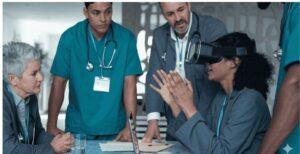
XR Training Solutions for Healthcare Providers: Transforming Medical Education with Immersive Technology
Healthcare education has always needed a balance between classroom learning and practical experience. However, traditional methods like textbooks, lectures, and limited simulation labs often fall short in preparing professionals for real-world medical challenges.
This is where XR training solutions are transforming the healthcare industry.
XR uses a mix of immersive technologies to create realistic training simulations that allow healthcare professionals to learn, practice, and respond to complex medical situations in a controlled environment.
Hospitals, medical schools, and training institutions are increasingly turning to XR technology to enhance medical education, strengthen clinical skills, and create safer training environments.
What is XR Training in Healthcare?
XR training in healthcare uses immersive technologies to recreate real medical environments and medical procedures for education and hands-on practice.
Rather than relying only on theoretical learning, healthcare professionals can step into interactive 3D environments to practice procedures, diagnose virtual patients, and manage clinical situations.
XR training typically includes:
- Virtual Reality (VR) for fully immersive simulations
- Augmented Reality (AR) for overlaying digital information on the real world
- Mixed Reality (MR) for combining physical and digital environments
The integration of these technologies delivers hands-on learning opportunities without the risks associated with real-world training.
Why Traditional Medical Training Has Limitations
While traditional medical training methods are still valuable, they come with several challenges:
Limited Practical Exposure: Medical students and trainees often have few chances to practice procedures before performing them on real patients.
High Training Costs: Operating physical simulation labs and maintaining training equipment and medical models often involves significant costs.
Risk to Patients: Performing complex procedures on real patients involves unavoidable risks.
Limited Scenario Variety: Conventional training setups often struggle to replicate rare or high-risk medical scenarios.
Key Technologies Powering XR Healthcare Training
Virtual Reality (VR) Medical Training
VR provides a fully immersive digital space where healthcare professionals can engage with patients, medical equipment, and realistic clinical scenarios.
VR training applications include:
- Surgical procedure simulations
- Emergency room training
- Anatomy visualization
- Trauma response practice
VR headsets allow trainees to step into highly realistic clinical scenarios that replicate real hospital settings.
Augmented Reality (AR) Medical Learning
AR enriches the real world by superimposing digital elements like 3D models, medical information, or step-by-step instructions.
In healthcare training, AR can be used to:
- Display anatomy on real patients
- Guide medical procedures
- Assist with medical device training
- Improve clinical visualization
This technology helps healthcare professionals learn while interacting with real-world environments.
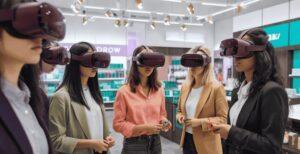
Mixed Reality (MR) for Collaborative Training
Mixed reality combines real and virtual elements, letting users interact with both at the same time.
MR is particularly useful for collaborative medical training, where multiple trainees can participate in the same simulation.
Applications include:
- Surgical planning
- Team-based emergency response training
- Medical education demonstrations
How XR Training Works in Healthcare
XR healthcare training typically follows a structured workflow.
Step 1: Choose a Training Scenario: Users select a training module, such as surgery simulation, patient diagnosis, or emergency response.
Step 2: Enter an Immersive Environment: With XR devices, trainees can step into realistic medical environments like operating rooms or emergency departments.
Step 3: Interact with Virtual Patients and Equipment: Trainees practice procedures, handle medical equipment, and make critical decisions just as they would in real clinical settings.
Step 4: Receive Real-Time Guidance: The system offers real-time prompts, guidance, and feedback to support trainees throughout the simulation.
Step 5: Analyze Performance: The training platform tracks trainees’ actions, decisions, and accuracy to assess their performance.
Real-World Use Cases of XR Training in Healthcare
XR technology is being applied in a wide range of healthcare training programs.
Surgical Training
XR simulations let surgeons rehearse complex procedures in a virtual setting before performing them in the operating room.
Examples include:
- Orthopedic surgery
- Neurosurgery
- Laparoscopic surgery
- Cardiovascular procedures
Emergency Medical Training
Emergency scenarios require quick decision-making and coordinated teamwork.
XR can simulate situations such as:
- Cardiac arrest
- Trauma injuries
- Disaster response
- Mass casualty incidents
Medical Education and Anatomy Learning
Medical institutions are increasingly using XR to bring human anatomy to life, allowing students to explore detailed 3D models in an interactive and immersive way.
Students can:
- Explore organs and body systems
- Observe physiological processes
- Practice clinical procedures
This approach improves understanding compared to traditional 2D diagrams.
Nursing and Patient Care Training
Nurses can build and refine their clinical skills through realistic, immersive simulations that mirror real-world patient care scenarios.
Training modules may include:
- Patient monitoring
- Infection control
- Medication administration
- Emergency response
XR training improves confidence and patient care skills.
Benefits of XR Training for Healthcare Providers
Risk-Free Learning Environment: Healthcare professionals can rehearse procedures in a controlled, risk-free environment, ensuring patient safety is never compromised.
Faster Skill Development: Immersive learning experiences enhance retention and enable trainees to grasp concepts more quickly and effectively.
Reduced Training Costs:XR minimizes reliance on costly physical simulators and dedicated training facilities, making advanced training more accessible and efficient.
Realistic Medical Scenarios: XR environments are designed to mirror real-world hospitals, operating theatres, and clinical settings with remarkable accuracy.
Repeatable Training Simulations: Trainees can revisit procedures as often as needed, building confidence and precision until the skills are fully mastered.
Data-Driven Performance Tracking: Training platforms capture detailed data to evaluate performance, track accuracy, and monitor each learner’s progress over time.
Who Uses XR Healthcare Training Solutions?
XR training is used by various healthcare organizations, including:
- Hospitals and healthcare systems
- Medical schools and universities
- Nursing education programs
- Pharmaceutical companies
- Medical device manufacturers
- Emergency response training organizations
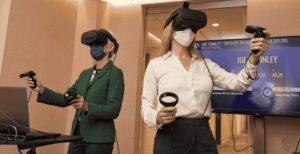
The Future of XR in Healthcare Training
The adoption of XR technology in healthcare is expected to grow significantly in the coming years.
Future developments may include:
- AI-powered adaptive learning systems
- Remote collaborative training environments
- Hyper-realistic patient simulations
- Integration with robotic surgery training
As healthcare continues to evolve with technology, XR training is set to become a key tool in equipping the next generation of professionals with the skills they need.
XR training is reshaping how healthcare professionals learn and refine their skills. By blending VR, AR, and mixed reality, it offers immersive, hands-on experiences that are both safe and highly effective.
From surgical practice to emergency scenarios, it allows clinicians to build critical skills in realistic environments without any risk to patients. As adoption grows, XR is quickly becoming a core part of modern medical training and development.