
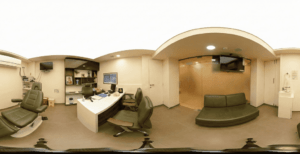
Hospitals can seem unusual. Most people only go there when they have to. Waiting rooms, long corridors, maybe a nurse rushing by. Rarely does anyone see behind the scenes—the labs, the ICU, the imaging rooms, or even how all the equipment fits together.
Free virtual hospital tours, or 360° medical facility tours, let people do that. They don’t make someone a doctor or replace real experience, but they do let people see what’s usually off-limits. Sometimes that’s enough.
Inside Reception and Waiting Rooms
The first thing that usually grabs attention is the reception area. There’s the desk, chairs all over the place, maybe a play area for kids. Sometimes a coffee machine is tucked in a corner—I’m not sure why, but it’s there. Pamphlets stacked on a table catch the eye, not because they’re important, but just because they’re there.
Chairs are angled differently. Some face TVs, some face windows, and some face each other. At first, it seems random, but then you notice people move differently around them. Staff can get to desks easily, and it all sort of makes sense.
Waiting rooms are funny because at first glance, they look plain. But looking around slowly, you notice the little things. A hand sanitizer station in a corner, a trash bin almost invisible, a water cooler behind a chair. Stuff like that. Sometimes it seems silly to notice these things, but it’s actually interesting once you start paying attention.
Ward Overview
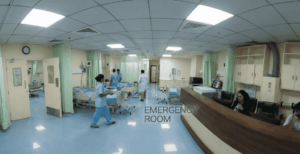
Patient wards are a bit more complicated. Beds, monitors, tables, curtains—packed together, but somehow functional. At first glance, the ward appears crowded.
After a few passes through the tour, it starts to make sense. Monitors are in a spot where nurses can see them without leaning over, beds have enough space to move, curtains give some privacy. Even small trays on counters and bins tucked away all start to make sense after a while.
Sometimes rooms look identical, but little differences matter. The angle of a monitor, the placement of a bin, a chair slightly off. Going back again in the tour, you notice things you missed before. That repetition is actually helpful, even if it feels a bit redundant.
A Look at Diagnostic Rooms
Labs are a mess if you just read about them, with machines, tubes, racks, and labels everywhere. Textbooks don’t prepare you for it, but seeing them in 360° makes it clear.
Each machine has a place, racks are lined up, gloves are nearby, and there are tiny labels you might not even notice at first. It’s easy to spend more time than planned noticing small details that wouldn’t seem important, but actually tell a lot about workflow.
Diagnostic rooms like MRI or X-ray are even stranger. Machines everywhere, cables running across the floor, headphones for patients, and warning signs on the walls.
At first, it’s confusing, but moving around slowly, it clicks. Patients move along certain paths, staff have easy access to controls, and safety is built into the setup. Even small things like a table or chair angle start to make sense after a few passes.
No-Rush Learning
One big thing about virtual tours is that there’s no pressure. Miss something? Go back. Confused about a machine? Zoom in, check again.
Real hospital visits don’t allow that: there’s someone watching, a tour guide rushing you, and the worry about being in the way. That freedom makes a difference.
It’s normal to get distracted. Attention jumps from a monitor to a tray to a bin to a little chart on the wall. Humans notice what catches their eye. And noticing these small things actually helps make sense of the bigger picture, weirdly enough.
Supporting Real Experience
These tours aren’t a substitute for real experience. Hands-on practice, supervision, and patient care are essential. But they work as guides. Seeing how rooms are arranged, how staff move, how equipment is set up, helps make real hospitals less confusing.
Small details like monitor angles, tray placements, or cable setups suddenly click. It’s comforting, especially for learners—it makes hospitals feel a little less intimidating.
Learning Without Barriers
Cost, permissions, and travel usually limit access to hospital areas. Free 360° tours remove that. Students, volunteers, or anyone curious can explore labs, wards, ICUs, imaging rooms, all without leaving home.
And since it’s virtual, repetition is easy. Rooms can be revisited. Details that might be missed in real visits—bins, small equipment, labels—can be noticed multiple times.
Even though it’s not the same as being there, it gives a surprisingly real sense of space. Observing arrangements casually builds understanding and familiarity, even if it’s not perfect.

Demystifying Hospital Environments
Hospitals are intimidating, especially ICUs, labs, and emergency rooms. These areas are full of machines, staff, and rules.
Explore at your own pace, focus on areas that seem confusing, revisit spots as needed. Even though it’s virtual, it reduces intimidation.
Small things matter: a little bin in the corner, a chart leaning against a wall, a tray placed oddly. Noticing these things shows how hospitals function as systems, not just random rooms with machines. It’s oddly satisfying to notice details most people ignore.
Free virtual hospital tours and 360° medical facility tours give access to spaces that are usually restricted or intimidating. They let people explore freely, notice details, and understand workflows at their own pace. Minor observations that would be missed in person can be studied over and over.
While these tours don’t replace hands-on training or patient care, they act as a helpful guide. Sometimes learning doesn’t need more textbooks, lectures, or simulations.
Sometimes all it takes is the ability to see spaces clearly, explore freely, and notice what really matters. That small freedom—just being able to explore—can make a surprisingly big difference in understanding hospitals.