

Precision, safety, and customer experience are at the core of the travel and transportation industry. whether for airline crews, rail operators, or logistics teams managing complex operations.
However, traditional training methods often struggle to simulate real-world scenarios effectively. This is where virtual reality (VR) training is making a significant impact.
With lifelike virtual environments, VR is helping professionals learn faster, practice better, and perform more confidently in real situations.
What is VR training?
Virtual reality training lets users step into lifelike digital worlds where they can actively engage, practice, and learn through immersive, hands-on experiences.
- Airport terminals
• Aircraft cabins
• Railway stations
• Warehouses and logistics hubs
• Public transport systems
Within these immersive environments, users can engage, make real-time decisions, and carry out tasks just as they would in real-world situations.
Why the Industry Needs VR Training
Conventional training approaches—like manuals, classroom sessions, and basic physical simulations—often come with noticeable limitations:
- Lack of real-world exposure
• High training costs
• Safety risks during live drills
• Inconsistent training experiences
Virtual reality training overcomes these challenges by delivering safe, scalable, and consistently repeatable learning experiences.
Key Components of VR Training Systems
1. Immersive Hardware: VR training starts with equipment like headsets, controllers, and motion sensors, allowing users to interact naturally within immersive virtual environments.
2. Simulation Software: The software builds realistic environments and scenarios designed around specific industry needs, such as airport operations or fleet management.
3. Scenario-Based Learning: Training modules are designed around real-world situations, including:
1. Emergency handling
2. Customer service interactions
3. Equipment operation
4. Safety procedures
4. Performance Tracking: Advanced VR systems track user performance—such as reaction time, accuracy, and decision-making—to assess progress and enhance training outcomes.
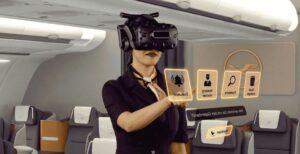
How VR Training Works
The process is straightforward but highly effective:
Step 1: Select a training scenario.
Step 2: Enter a virtual environment using VR equipment.
Step 3: Perform tasks and interact with the environment
Step 4: Receive feedback and performance analysis
Step 5: Repeat training for improvement
This cycle ensures continuous learning and skill development.
Real-World Use Cases
1. Aviation Training: Airlines use VR to train cabin crew and pilots in:
- Emergency evacuations
• Passenger management
• Safety drills
• In-flight service scenarios
2. Airport Operations: Ground staff can practice the following:
- Baggage handling
• Security procedures
• Passenger flow management
• Crisis response
3. Railway Systems: VR helps train staff in:
- Platform safety
• Train operations
• Passenger handling
• Emergency response
4. Public Transport & Fleet Management: Bus drivers and fleet operators can learn the following:
- Defensive driving techniques
• Route familiarization
• Hazard perception
• Customer interaction
5. Logistics & Supply Chain: Warehousing and logistics teams benefit from:
- Equipment operation training
• Inventory management
• Safety compliance
• Workflow optimization
Benefits of VR Training
Safer Learning Environment: Employees can train for high-risk situations without facing real-world risks or consequences.
Quicker Skill Development: Immersive experiences help learners grasp concepts faster and retain them more effectively than traditional methods.
Reduced Costs: Cuts down expenses related to physical setups, travel, and equipment maintenance.
Uniform Training Delivery: Ensures the same high-quality training experience across different teams and locations.
Stronger On-the-Job Performance: Better training leads to fewer mistakes and more efficient operations.
Better Customer Experience: Well-prepared staff can respond more confidently and effectively, enhancing customer satisfaction and overall brand perception.

Challenges to Consider
While VR training brings significant benefits, organizations should also keep a few factors in mind, such as the initial investment in hardware and software, the need for customized content, and ongoing technical support and maintenance. The good news is that rental options are now available, making it easier to adopt VR without a large upfront cost.
The Future of VR in Travel & Transportation
VR training is advancing quickly, with innovations like AI-powered adaptive learning, multi-user collaborative environments, real-time data integration, and increasingly realistic simulations. As the technology continues to mature, it is set to become a core tool for training and workforce development.
In the travel and transportation sector, there’s little room for error—training needs to be reliable, scalable, and safe. VR training meets these demands effectively. Organizations that embrace immersive learning today aren’t just upgrading skills; they’re creating safer operations, delivering better customer experiences, and preparing their workforce for the future.