
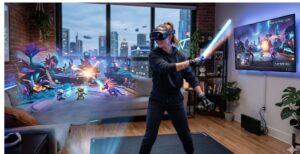
By 2026, free VR games are no longer just small experiments or short demos that you uninstall after ten minutes. Hardware has improved, engines are more stable, and developers now understand how people actually move and react in virtual reality. Because of that, many free VR games now feel complete and worth coming back to.
Not every free VR game is good. Some exist only to push cosmetic items. Others rely entirely on multiplayer chaos. But there are also games that work because the core idea is solid, even without a price tag. This list focuses on those games. These are titles you can install, play properly, and return to in 2026 without feeling like you are missing half the experience.
Support varies by headset, but most of these games work on modern standalone headsets and PC VR setups. This list is not ranked.
Rec Room
Rec Room is built around the idea that players create the content. Instead of one main world, the game is split into hundreds of rooms made by the community. Some rooms are simple social spaces. Others are full games with rules, teams, and scoring.
You might spend one session playing a casual activity and the next walking into a strange horror room someone built for fun. The quality is inconsistent, but the freedom is what keeps people coming back. You can talk, play, build, or just hang out. It does not push you toward one specific way to play.
VRChat
VRChat is one of the earliest examples of what social VR could become. It gives players almost complete freedom to build worlds, avatars, and activities. That freedom is the reason no two sessions feel the same.
You can explore environments made by other players, attend live events, or just talk to strangers in social hubs. Because the community is large and diverse, experiences vary a lot. Some are creative and impressive. Others can feel chaotic or uncomfortable. For people who like open-ended social experiences, VRChat still offers something unique.
Gorilla Tag
Gorilla Tag focuses entirely on movement. You do not use traditional controls to run. Instead, you move by pushing and pulling yourself with your arms. At first, this feels awkward. After some practice, it becomes fast and physical.
Most game modes are based on tag-style rules, where players chase each other across different maps. Between matches, players gather in social areas and customize their characters. It is loud, energetic, and not for everyone, but the movement system keeps people hooked.
Big Ballers
Big Ballers tries to bring multiple sports into one VR game. Instead of focusing on realism, it emphasizes physics that feel right when throwing, catching, or hitting objects.
You can switch between sports without learning completely new systems each time. Multiplayer matches can get messy, especially with more players, but that chaos is part of the appeal. It is easy to start playing, but timing and positioning take practice.
Orion Drift
Orion Drift takes social movement-based gameplay and places it in large-scale space environments. You play as a robotic character moving through space stations filled with activities and other players.
Some modes focus on team-based sports played across large maps. Movement feels floaty but controlled. Sessions work best when you treat the game as a shared playground rather than a serious competition.
Propagation VR
Propagation VR is a focused horror shooter. You are placed in tight environments and asked to survive waves of enemies using limited weapons. There is very little exploration, and that keeps the tension high.
Each session is relatively short, but difficulty increases quickly. If you enjoy horror games that reward accuracy and awareness, this one still holds up in 2026.
Moon Rider
Moon Rider is a rhythm game that runs through a web browser on supported headsets. The gameplay is simple. You punch and dodge notes as they move toward you along a track.
Because it relies on community-supported music, the song selection is large. It is not as polished as paid rhythm games, but it works well enough to stay fun and physically demanding.
RaceRoom Racing Experience
RaceRoom Racing Experience offers a realistic racing simulation with a selection of free cars and tracks. The handling model focuses on realism, which means mistakes are noticeable.
In VR, depth perception makes cornering and speed easier to judge. While much of the content is paid, the free portion is enough to understand why the game is respected among racing fans.
FPS Infinite
FPS Infinite combines first-person shooting with procedural generation. Each run changes enemy placement, weapons, and objectives.
The visual style is stylized rather than realistic. Gameplay rewards movement and adaptability more than memorization. Because no two runs are the same, the game stays unpredictable.
République VR
Republique VR focuses on stealth and story rather than fast action. You guide a character through restricted environments while avoiding detection.
Combat exists, but it is rarely the best option. The episodic structure makes the game feel more like an interactive series than a sandbox experience. Atmosphere and voice acting do much of the work.
The Lab
The Lab is a collection of small VR experiences designed to demonstrate different interaction ideas. Some focus on combat, others on exploration or simple tasks.
It is aimed at newer VR users, but it still works as a relaxed way to experience different styles of VR interaction. Despite its age, it remains useful and enjoyable.
The Blu
The Blu is more of an experience than a game. It places you underwater and lets you observe marine life up close.
There are no objectives or scores. The appeal comes from scale, atmosphere, and realism. It works best when you take your time and simply look around.
Shattered Lights
Shattered Lights focuses on psychological tension. Movement is tied to your real-world steps, which makes every action feel deliberate.
With minimal tools and strong sound design, the game creates discomfort without constant threats. It is short, but memorable.
Aircar
Aircar places you inside a futuristic flying vehicle and lets you explore a dense city. There is no combat and little structure.
Controls are smooth, and the visual style carries the experience. It is best played slowly, without rushing toward objectives.
Cards & Tankards
Cards & Tankards combines a collectible card game with a social VR space. Matches are turn-based, making it easy to talk while playing.
The tavern setting adds atmosphere, and interaction with other players is central. It works well for players who prefer slower-paced multiplayer games.
Exer Gale
Exer Gale turns your arms into wings. Movement relies on physical motion, which can be tiring but also satisfying.
You can race competitively or explore environments at your own pace. The game supports both focused play and relaxed sessions.
Cactus Cowboy—Plants At War
Cactus Cowboy uses an unusual premise to deliver a structured shooter. Weapons feel solid, and levels are designed around clear objectives.
It does not take itself too seriously, but gameplay remains consistent. For players looking for something different from standard shooters, it stands out.
What You Actually Get From These Games
Free VR games in 2026 are no longer limited to small experiments. While quality still varies, the best free titles provide real value without requiring money upfront. Whether you prefer social spaces, horror, racing, or relaxed exploration, there are enough solid options to keep VR interesting.
These games are not perfect, but they are playable, supported, and still relevant. That is what makes them worth installing.