
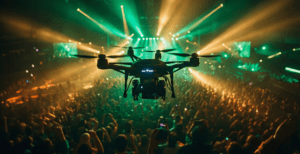
A drone used at concerts and music festivals is basically a flying camera. That’s it. No taste in music, no understanding of rhythm or emotion, and no idea who the crowd came to see. Someone stands offstage and controls it. If that person stops giving input, the drone does nothing useful. On its own, it is nothing.
People think drones make concerts “bigger” or “more magical.” They don’t. A drone does not feel the bass. It does not know when a chorus hits harder. It does not understand crowd energy or silence before a drop. It only moves where it is told to go; up means up, forward means forward. It records what already exists.
Most drones used at concerts carry cameras. Those cameras capture visuals. They don’t perceive music the way humans do. They don’t understand why a moment matters. Humans later watch that footage and decide what it means. The drone only provides another angle. Sometimes that angle adds value; sometimes it adds nothing. That depends entirely on how it is used.
People often expect drones to automatically improve live music experiences, but they don’t: a dull performance stays dull, even from the air. A drone changes perspective, not emotion.
Why Concerts and Festivals Started Using Drones
Live music events are crowded, loud, and visually complex. Stages, lights, people, screens, smoke, and movement all happen at once. Cameras have always been part of concerts, but traditional cameras have limits. They are fixed. They sit on cranes. They move on rails. They require operators close to the crowd.
Drones were introduced at concerts not for artistry, but for practicality. They could move above people, show scale without blocking anyone’s view, and capture angles that ground cameras could not reach safely.
Cost also mattered because large crane systems and cable cams are expensive and slow to set up. Drones reduced that effort. One drone could capture wide shots that once required heavy infrastructure.
Safety played a role as well. Instead of placing camera operators in dense crowds or near pyrotechnics, drones allowed distance. The operator stayed away. The drone did the movement. Drones did not replace traditional cameras. They filled gaps.
How Drones Are Actually Used at Concerts and Music Festivals
Showing Crowd Scale
One of the most common uses of drones at music festivals is showing crowd size. From the ground, crowds feel chaotic. From above, scale becomes clear. Thousands of people moving together. Lights stretching across open land. Stages surrounded by sound and motion.
The drone does not create excitement. It simply shows how large the event is. The audience understands the scale instantly. This is why drone shots are often used in opening visuals or promotional videos. The drone does not explain why people are excited. It only shows that they are.
Stage and Venue Context
At large festivals, stages are often spread across wide areas. Drones are used to show where stages sit in relation to each other. How crowds move between them. How the venue looks as a whole.
These shots help viewers understand the environment. Whether it’s an open field, a beach, a desert, or an urban space, drones show context quickly. No explanation is needed. The place speaks for itself.
Live Stream and Broadcast Support
In live-streamed concerts or televised music events, drones are rarely the main camera. They support coverage. They add wide shots between songs or during transitions. They help reset the visual rhythm.
Drones are often used before performances start. Empty grounds. Early crowds. Sunset visuals. These shots build atmosphere. They don’t replace close-ups of artists or instruments.
During performances, drone use is strictly controlled; drones must not interfere with performers, lights, or pyrotechnics, and they must stay at a safe distance while moving carefully.
Capturing Movement and Flow
Music festivals are not static. People move constantly. Between stages. Between food areas. Between entrances and exits. Drones capture this movement clearly.
From above, patterns appear. Where crowds gather. Where they thin out. How energy shifts across the venue. Ground cameras struggle to show this continuously. Drones can.
Again, the drone does not decide where to go; a human plans the path, and the drone follows instructions. If the plan is bad, the footage is useless.
Crowd and Safety Monitoring
Large concerts involve more than music. Crowd safety is critical. Drones are often used by organizers to monitor crowd behavior from above.
From the ground, congestion is hard to see. From the air, problem areas appear quickly. Where people slow down. Where pressure builds. Where movement stops.
This footage helps security teams react faster. The drone does not manage crowds. It does not make decisions. Humans do. The drone only shows what is happening in real time.
Drones in Different Types of Music Events
Large Music Festivals
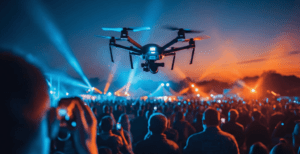
At massive festivals, drones are used mainly for scale and atmosphere. Wide shots. Sunrise and sunset visuals. Crowd waves. These shots are often used in after-movies and promotions.
They are rarely used continuously during performances. Overuse makes footage repetitive and distracting.
Stadium Concerts
In stadium shows, drones are used carefully. Indoor restrictions, roof structures, lighting rigs, and safety concerns limit flight.
When used, drones capture high-angle views of crowds and stage layouts. They add context, not intimacy. Close-ups still come from ground cameras.
Electronic Music Events
Electronic music festivals use drones more often because visuals matter heavily. Light shows, lasers, and crowd movement look striking from above.
Still, drones are planned tools. They do not move freely during drops or heavy effects. Safety overrides spectacle.
Outdoor and Remote Events
Desert festivals, beach concerts, and mountain music events benefit most from drones. These locations are hard to cover with traditional equipment.
Drones show how music exists within the environment. The land becomes part of the experience. Here, drones add context rather than drama.
Behind the Scenes: Control and Responsibility
Concert drones are not toys. They are operated by licensed professionals. Rules are strict. Permissions are required. Flight paths are planned in advance.
Crowds make drone flying risky; one failure can cause injury. That’s why drones are flown cautiously: safety comes first, creativity comes second. If weather conditions change or crowds become unpredictable, drones stay grounded. No shot is worth a risk.
Impact of Drones on Live Music Experiences
Drones did not change music. They changed documentation. Concerts are now seen from angles that were once impossible or too expensive. Audiences are used to aerial shots now. They no longer feel special.
That raises expectations. A drone shot must serve a purpose. Otherwise, it feels empty. When used well, viewers don’t notice the drone. They notice the scale, the energy, the moment. When used poorly, the drone becomes obvious and distracting.
Overall Impact
Drones at concerts and music festivals are not creative tools. They are support tools. They help organizers, broadcasters, and viewers see more clearly. A drone does not understand music or feel emotion—people do. The drone only observes and moves.
That is why drones work in live music events. Not because they are impressive machines, but because they quietly show what already exists. When used properly, no one thinks about the drone at all, and they only remember the music.