

Every large company in India spends money on employee training. Most of it does not work.
This is not a controversial claim. Ask any HR director privately and they will tell you. Classroom sessions that people sit through without genuine engagement, watching the clock. Online modules clicked through as fast as the system allows to get the completion certificate and move on. Mandatory training delivered because compliance requires it rather than because anyone genuinely believes it will change behaviour or improve performance.
The waste is enormous. The corporate training industry in India is genuinely large — billions of rupees spent annually across organisations of every size and sector. The proportion of that spending that delivers measurable behaviour change rather than simply fulfilling a training requirement is, by honest assessment, small.
The problem is not the content. Most corporate training content is adequate. The problem is the delivery mechanism. Passive consumption of information — sitting in a room while someone presents at you, reading slides on a screen, watching videos — activates none of the neural pathways that genuine skill development requires. Human brains do not learn complex skills by being told about them. They learn by doing them. And conventional corporate training almost never involves doing anything.
VR training changes this at the level of the delivery mechanism rather than the content. It replaces passive consumption with active experience and produces genuinely different results.
Why VR Training Produces Better Outcomes
The core mechanism is straightforward. VR places the trainee inside the scenario rather than in front of a description of it. A customer service representative practicing a difficult client conversation in VR is not being told how to handle an angry customer — they are handling one, making real-time decisions, observing consequences, and developing genuine response patterns through experience rather than through instruction.
A worker practicing fire evacuation procedures in a VR simulation of their actual workplace is not memorising a procedure — they are executing it, building the muscle memory and spatial familiarity that means when a real emergency occurs their response is instinctive rather than recalled. The difference between an instinctive response and a recalled one in an emergency situation is the difference between the training working and the training failing at the moment it matters most.
Research consistently demonstrates the same pattern. VR-trained employees show better retention of content, better transfer of learning to real situations, and higher confidence in applying new skills than employees who received the same content through conventional delivery methods. The difference is not marginal — it is significant enough to change the ROI calculation for corporate training investment substantially.
The Applications That Command the Strongest Business Case
Safety training is the most immediately compelling application because the stakes are clearest and the ROI is most directly calculable. Industries with genuine physical safety requirements — manufacturing, construction, chemical processing, oil and gas, logistics, healthcare — have both regulatory obligations to train their workforces and concrete financial and human cost consequences when training is inadequate.
A manufacturing company that has experienced even one serious workplace incident resulting from inadequate emergency response knows exactly what better training is worth — in regulatory penalties avoided, in compensation costs avoided, in the human cost of injury or death that preventable incidents carry. A VR safety training program that demonstrably improves emergency response capability is not an optional investment for this client. It is a business necessity that justifies premium fees and creates the kind of value-justified client relationship that sustains a training business over the long term.
Customer service training where employees practice difficult conversations in simulated environments generates measurable improvement in customer satisfaction scores for companies that implement it properly. The ability to show a client service director that their team’s handling of complaint calls improved by a measurable percentage after VR training is a commercial argument that speaks directly to business outcomes they are already measured on.
Leadership training where managers rehearse giving difficult feedback, managing conflict, and navigating high-stakes conversations gives organisations a way to develop leadership capability that conventional training workshops have never been able to deliver effectively. The skills that matter most in leadership development are almost entirely interpersonal and almost entirely impossible to develop through instruction alone — which is exactly where VR simulation has its most powerful application.
Sales training, compliance training, onboarding programs that immerse new employees in the company’s environment and culture, medical and clinical skills development — every one of these applications has a genuine and demonstrable VR advantage over conventional alternatives.
Building the Client Base
Corporate training decisions are made by HR directors, Learning and Development managers, and in larger organisations by Chief People Officers or equivalent senior executives. These are not impulsive buyers. They make considered, committee-involved decisions based on demonstrated capability, measurable outcomes, and references from organisations they trust.
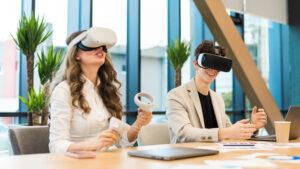
The most effective approach to building this client base is demonstration — getting decision-makers inside a VR training experience so they feel what their employees would feel rather than being told what their employees would feel. A thirty-minute demonstration session where a potential client’s HR director and two or three of their employees experience a VR safety or customer service training scenario generates more genuine conviction than any amount of case study material, reference calls, or presentation slides.
Start with industries where the safety training case is most immediately compelling — manufacturing, construction, chemical processing. These sectors have the clearest regulatory drivers, the most concrete ROI calculation, and the most straightforward business case for a first pilot program. A successful pilot program in one department of a manufacturing company generates the internal advocacy that expands the engagement to other departments and other sites.
Measuring and Demonstrating Outcomes
The single most important commercial competence in this business is the ability to measure and report training outcomes. This is what distinguishes a training business that clients keep from one they try once and replace.
Build assessment capability into every training program from the beginning. Pre-training assessment establishes the baseline. Post-training assessment quantifies the improvement. Follow-up assessment at thirty and ninety days demonstrates retention. Where clients will share real-world performance data — customer satisfaction scores, incident rates, compliance audit results — correlate training outcomes with performance outcomes.
The ability to say to a client that your VR safety training program was associated with a measurable reduction in near-miss incidents, or that your customer service VR training was associated with a measurable improvement in first-call resolution rates, is worth more than any marketing material. It is the kind of evidence that creates clients who renew contracts, expand programs, and refer you to their professional networks with genuine conviction rather than polite endorsement.
Equipment, Operations, and Getting Started
Equipment for this business can be rented from us for specific client training deployments while you build your client base and validate your content with real corporate clients. A manufacturer that wants to run a pilot safety training program with one team before committing to a company-wide deployment does not require you to own a headset fleet before you have validated the relationship.
As specific corporate clients commit to ongoing training programs and your deployment frequency builds, purchasing your own fleet through us becomes the financially obvious decision. We can advise on the headset configuration and management software that best serves corporate training deployments specifically — because the requirements differ meaningfully from consumer entertainment deployments and the equipment choices should reflect that difference.
The operational model for corporate training deployments is typically mobile rather than fixed. You bring the equipment to the client’s site, set up in their training room, run the sessions, and pack down. The logistical capability to set up a professional VR training station in under an hour and deliver consistent, reliable experiences across multiple deployment locations is an operational competence that distinguishes professional training businesses from the improvised operations that give clients justification for choosing conventional alternatives.
The Honest Case for This Business
The corporate training market in India is large and the budgets are real. The frustration with conventional training approaches is genuine and widespread among the HR professionals who are responsible for spending those budgets. The appetite for alternatives that demonstrably work rather than simply comply is growing alongside the sophistication of learning and development thinking in the Indian corporate sector.
VR training is not a future technology being positioned for a future market. It is a present capability being positioned for a present frustration that existing budgets are already allocated to addressing inadequately. The businesses that establish credibility in this market now — by delivering measurable outcomes and building the client relationships that come from consistently doing so — will be the established providers that future entrants find genuinely difficult to displace.
We have the equipment to start. The training content, the client relationships, and the outcome measurement capability are yours to build.
Build them with genuine commitment to delivering results, and the market will sustain you for a long time.