
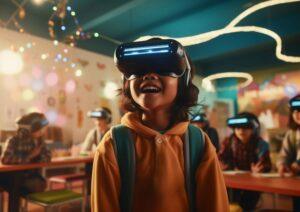
The Game That Puts You Inside It Requires Something Completely Different to Create
Playing a VR game feels, at its best, like the most natural and immediate interactive experience imaginable—you are there, the world responds to you, and the sense of physical presence in the virtual environment is genuine and immediate. The game disappears, and the experience takes over.
Creating that feeling is among the most technically and creatively demanding work in contemporary software development. The development process behind a high-quality VR game involves disciplines, decisions, and technical challenges that have no equivalent in conventional game development — and understanding what those challenges are illuminates both why great VR games are genuinely impressive achievements and why the medium is developing more slowly than some early predictions suggested.
The Presence Problem — The Central Technical Challenge of VR Game Development
Every other consideration in VR game development is subordinate to the presence problem — the challenge of creating the technical conditions under which a human brain accepts a virtual environment as genuinely present rather than as a screen-mediated representation of an environment.
Presence is not a feeling that players consciously create. It is a neurological state that the technical execution either triggers or fails to trigger. The VR experience that achieves presence is the one where the player stops thinking about the headset and starts reacting to the environment as though it were real. The VR experience that fails to achieve presence is the one where the headset remains a constant conscious presence and the virtual environment remains a display rather than a place.
The technical requirements for presence creation are specific and unforgiving. Frame rate must remain consistently above the threshold—typically 90 frames per second—below which the visual inconsistency creates the motion-perception mismatch that causes motion sickness rather than presence. Latency between head movement and display update must remain below approximately 20 milliseconds—the threshold above which the lag between physical movement and visual response breaks the sense of presence. Tracking accuracy must be precise enough that the virtual body representation — the hands, the arms, the physical tools the player manipulates — corresponds faithfully to the player’s actual physical position and movement.
A conventional game that drops to 30 frames per second during a demanding scene is less visually smooth. A VR game that drops to 30 frames per second during a demanding scene is actively uncomfortable. This asymmetry shapes every technical decision in VR game development—optimization is not a quality-of-life consideration; it is a fundamental requirement for the game to be playable at all.
World Building for VR — Scale, Space, and Physical Reality
The world-building work of VR game development differs from conventional game world-building in ways that go beyond the obvious visual differences. The player in a VR game inhabits the world physically—they perceive its scale relative to their own body, they move through it in ways that activate genuine spatial perception, and they interact with it using their actual hands rather than controller inputs mapped to an on-screen character.
Scale is the first and most immediately impactful difference. Objects in a VR game must be built to human scale—the table that is at the right height for a player standing in the space, the doorway that feels like an actual doorway rather than a game-convenient portal, and the landscape that conveys genuine geographic scale rather than the compressed scale that works for screen-mediated games. Getting scale wrong in VR does not just look odd — it breaks the sense of presence because the player’s spatial perception is highly sensitive to scale anomalies.
The design of physical space in VR environments must account for the player’s actual physical movement rather than just the navigational logic of the game. Room-scale VR games that allow physical walking must be designed around realistic physical space dimensions. Locomotion systems—the teleportation, the smooth movement, and the physical repositioning mechanisms that VR games use to allow virtual travel beyond the physical space available—must be designed to minimize the presence-disrupting discomfort that poorly designed locomotion consistently creates.
The interactive objects in VR games—the items the player picks up, examines, throws, assembles, or uses as tools—must respond to interaction with physical accuracy that screen-mediated games do not require. An object that passes through a surface it should bounce off, that behaves unrealistically when dropped or thrown, or that fails to respond with the physical feedback the player’s hands expect breaks the sense of physical reality that VR presence depends on.

Audio Design — The Overlooked Foundation of VR Immersion
The audio design of VR games is consistently underappreciated by players and consistently identified as critical by developers who understand what separates genuinely immersive VR from technically capable but experientially flat VR.
Spatial audio—the system that places sounds at accurate three-dimensional positions in the virtual environment, that adjusts sound character based on virtual space acoustic properties, and that tracks sound source position relative to the player’s head position in real time—is the audio equivalent of high-resolution display. Without it, the visual immersion of the VR environment is undermined by the disconnect between what the eyes perceive and what the ears hear. With it, the audio environment becomes a component of presence rather than a background layer.
The design of environmental audio in VR games—the ambient sounds that characterize different spaces, the acoustic treatment that makes a large stone hall sound different from a small carpeted room, and the distance attenuation that makes approaching sounds feel genuinely approaching—is design work that requires the same attention and craftsmanship as the visual environment design.
The Iteration Cycle — Why VR Development Takes Longer
The development iteration cycle for VR games is longer and more resource-intensive than for conventional games for a specific reason—evaluation of VR game development progress requires headset testing rather than screen review.
The build that a development team reviews on a monitor for a conventional game is not the same as the build they review in a headset for a VR game. Visual choices, spatial design decisions, interaction design, comfort considerations — these all look and feel different in the headset than on the monitor, and the evaluation that matters for VR development quality is the headset evaluation.
This requirement for regular headset testing adds time and physical resources to the development cycle—every meaningful change requires headset evaluation that monitor-based evaluation cannot substitute for. Teams that attempt to shortcut this evaluation process consistently discover that the issues they missed in monitor review create significant problems in headset experience that require revision.
Companies like VRAshwa that have developed serious VR development capability understand this iterative reality—it is built into their development processes and their project timelines in a way that inexperienced VR developers consistently underestimate.
VR game development is the most demanding form of interactive experience creation currently practiced — technically demanding in ways that stress every component of the development pipeline and creatively demanding in ways that require rethinking assumptions that conventional game development made workable.
The games that succeed in VR—that create genuine presence, that use the medium’s capabilities rather than fighting against them, that leave players with the specific quality of experience that no other medium produces—are achievements that deserve the appreciation they receive.