
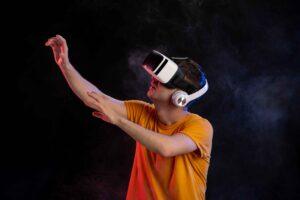
Why India Is Not Catching Up With the Global VR Gaming Market — It Is Building Its Own
The narrative of India’s relationship with global gaming has historically been a catching-up narrative—a large and enthusiastic gaming population engaging with games developed primarily for Western and East Asian markets, with India’s specific cultural contexts, gaming preferences, and market realities treated as local color rather than as design parameters.
The AR and VR gaming landscape that is developing in India in 2026 is writing a genuinely different narrative—one where Indian developers, Indian publishers, Indian gaming venues, and Indian technology companies like VRAshwa are building the AR and VR gaming experiences that Indian gamers specifically want and that Indian market conditions specifically enable.
This is not a story about India becoming the next gaming market for global products to enter. It is a story about India becoming a genuine origin point for gaming innovation that reflects its own cultural and market identity.
The Infrastructure Moment That Makes This Possible
The AR and VR gaming development that is happening in India in 2026 is enabled by infrastructure changes that have been building for several years and that have reached the critical mass where serious gaming investment is viable.
The 5G network rollout across Indian cities is the single most important infrastructure factor. The low-latency, high-bandwidth connectivity that AR and VR gaming requires — particularly for the multiplayer and cloud-rendered experiences that represent the most compelling consumer gaming applications — is becoming genuinely available in the urban markets where early AR and VR gaming adoption is concentrated.
The smartphone ecosystem that Indian gamers inhabit is relevant to AR gaming specifically. India has one of the largest and most actively engaged smartphone gaming populations in the world, and the AR gaming applications that run on smartphones — the most accessible and most immediately scalable AR gaming format — reach this population through devices they already own and already use for gaming.
The physical gaming venue ecosystem—the VR arcades, the gaming cafes, the family entertainment centers—is growing rapidly in Indian cities and creating the location-based AR and VR gaming experiences that are a specific and significant part of the Indian gaming market’s development pathway. Location-based gaming allows Indian gamers to access premium VR experiences without individual hardware ownership, and it creates the demonstration environments where people encounter VR for the first time and develop the desire for home access.
Cultural Specificity — The Design Choice That Changes Everything
The AR and VR games that are generating the most genuine enthusiasm among Indian players are not the games that most successfully localized global content for Indian audiences. They are the games that were designed from the beginning around Indian cultural content, Indian aesthetic sensibilities, Indian narrative traditions, and the specific Indian gaming preferences that years of engagement with Indian gamers have revealed.
The mythological and historical content that Indian gaming culture has consistently demonstrated an appetite for—the Mahabharata, the Ramayana, the Mughal period, the independence struggle, and the regional histories and folklore of India’s extraordinary cultural diversity—creates the narrative and world-building material for VR experiences that are genuinely distinctive from the fantasy and science fiction worlds that dominate Western VR gaming.
The competitive and social gaming dynamics that Indian gaming culture expresses — the local multiplayer enthusiasm, the family and community social contexts of Indian gaming, the specific competitive formats that Indian gamers have developed preferences for — create design parameters for Indian VR gaming that differ meaningfully from the design parameters that Western VR gaming has been built around.
VRAshwa’s engagement with Indian gaming content development reflects this cultural specificity understanding. The platforms and solutions VRAshwa provides to Indian gaming content developers and venues are designed for the Indian gaming context rather than adapted from Western gaming infrastructure.

The Esports and Competitive AR/VR Dimension
India’s esports ecosystem has developed rapidly enough that competitive AR and VR gaming is no longer a distant future scenario—it is an active current development with tournaments, organized competition structures, and the beginning of the professional player ecosystem that sustains competitive gaming at scale.
The specific competitive formats that work well for AR and VR—the physical movement, the spatial awareness, the real-world location integration of AR gaming—create competition formats that are genuinely distinctive from conventional screen-based esports and that create spectator experiences that are compelling in ways that require minimal gaming knowledge to appreciate.
The location-based AR gaming competitions that use real Indian urban spaces as their competitive arena—the historical sites, the cultural spaces, and the urban landscapes of Indian cities—create competitive events that are simultaneously gaming competitions and cultural experiences, a combination that Indian gaming’s specific cultural enthusiasm makes particularly resonant.
The Business of Indian VR Gaming — Where the Money Is and Where It Is Going
The commercial structure of Indian AR and VR gaming is developing along pathways that reflect Indian market realities rather than replicating Western gaming business models.
The location-based entertainment model—where gaming experiences are provided at venues rather than through individual device ownership—is a more significant component of Indian AR and VR gaming revenue than it is in Western markets, for the straightforward reason that individual VR headset ownership is at an earlier stage of adoption in India. This creates both the business opportunity for VR gaming venues and the deployment opportunity for companies like VRAshwa that supply and support the venue infrastructure.
The mobile AR gaming model—AR experiences delivered through smartphones that the Indian gaming population already owns—is the highest-volume AR gaming commercial pathway in the near term, and the content and platform development that is happening in India’s mobile gaming ecosystem is incorporating AR more rapidly than most international observers have recognized.
The AR and VR gaming revolution in India is real, it is current, and it is moving faster than the narrative of India as a gaming market latecomer suggests.
The developers who are building genuinely Indian VR gaming content, the venues that are bringing premium VR gaming experiences to Indian consumers through location-based models, and the technology companies like VRAshwa that are providing the platform infrastructure for Indian AR and VR gaming development — these are the entities that are building the Indian AR and VR gaming industry rather than waiting for it to arrive from elsewhere.