
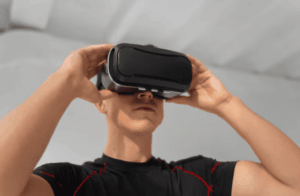
The Future That Is Being Built Right Now in Ways That Are Easy to Miss
Predictions about technology futures have a specific failure mode that makes most of them less useful than they appear — the failure mode of imagining the future as the present with the obvious problems solved, rather than imagining the genuinely new capabilities that the solved problems make possible.
The predictions for VR in 2030 that say the headsets will be lighter, the resolution will be higher, and the content library will be larger are technically accurate and practically useless because they describe the trajectory of obvious improvement without capturing the genuinely new experiences that trajectory will enable.
This is an attempt at an honest and genuinely useful assessment of where VR is going by 2030—grounded in the technology development that is currently underway rather than in optimistic extrapolation and focused on the experience changes that the technology changes will create rather than on the specification improvements themselves.
The Hardware Transition That Changes Everything
The single most significant change between current VR and 2030 VR will not be in resolution or processing power, although both will improve substantially. It will be in a form factor.
The transition from a headset to a glasses-form-factor mixed reality device—from a device that requires deliberate putting on and taking off, that communicates to everyone around the wearer that something unusual is happening, and that constrains use to specific sessions and contexts—to a device that is worn casually throughout the day in the way that glasses are worn, that is socially unremarkable, and that provides immersive capability as a feature of daily life rather than a designated activity, is the hardware transition that changes what VR and mixed reality are used for.
This transition is not speculative—it is already underway. The devices that bridge conventional glasses and spatial computing are in development at multiple major technology companies and the trajectory from current early versions to genuinely mainstream wearable form factors runs through the 2027-2030 window with reasonable confidence.
The implications of this form factor transition are profound. The use cases for spatial computing expand dramatically when the device is always available—the navigation overlay that appears when you need directions, the information layer that contextualizes what you are looking at, and the communication space that appears when you need to collaborate. These applications require always-available devices. They are not viable in session-based headset deployment.
Haptic Technology — When VR Becomes Something You Can Touch
The current VR experience has a specific and significant limitation that the most enthusiastic VR proponents have sometimes minimized—the absence of genuine physical feedback. You can see the virtual object. You can hear the virtual environment. You cannot feel what you touch.
The haptic technology that is in development as of 2026 and that will reach practical deployment quality by 2030 addresses this limitation with approaches that range from the practically near-term—gloves with actuator arrays that create the sensation of surface texture and object resistance—to the genuinely ambitious—full-body haptic suits that create spatial sensation across the body’s full surface.
The practical deployment that 2030 will see is most likely partial rather than comprehensive—haptic feedback for hands and arms in professional VR applications where the tactile feedback creates genuine value, with full-body haptics remaining a premium and specialist application rather than a mainstream feature.
Even partial haptic feedback changes the VR experience quality significantly. The surgeon practicing a procedure who can feel tissue resistance. The engineer examining a virtual prototype who can feel surface quality. The VR training participant who receives the physical feedback of a task done correctly or incorrectly. These applications cross a qualitative threshold when haptic feedback is present that purely visual VR cannot reach.
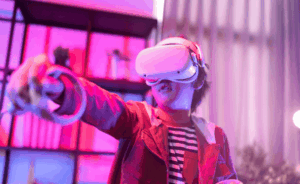
AI Integration — The VR World That Learns and Responds
The AI capability that is transforming every other digital experience category will transform VR specifically in the dimension of dynamic environment responsiveness—the virtual world that responds to user behavior intelligently rather than through scripted interaction.
The current VR environment is essentially a sophisticated pre-built space—the objects, characters, and interactions are designed and built ahead of the user’s arrival. AI integration allows the VR environment to generate and respond dynamically—the virtual characters who have genuine conversational intelligence rather than scripted responses, the virtual environments that adapt to user behavior patterns, the simulation scenarios that generate novel situations based on the training objectives rather than following pre-authored paths.
This AI-generated dynamism changes VR training applications most significantly. The training simulation that can generate infinite novel scenarios relevant to the training objective — rather than a finite library of pre-authored scenarios — creates a training resource that does not expire as trainees become familiar with the specific scenarios. The VR training landscape changes from a content library that needs regular replenishment to a generative system that creates contextually appropriate training experiences on demand.
VRAshwa’s development direction in enterprise training applications reflects awareness of this AI integration trajectory—the solutions being built now are designed for the AI-augmented capability that 2030 deployment will involve.
The Democratisation of VR Content Creation
The content production bottleneck that has limited VR’s consumer and enterprise adoption — the requirement for specialist technical skills to produce VR content and the consequent high production cost — is being dissolved by the combination of accessible production tools and AI-assisted content creation that is already developing rapidly.
By 2030, the production of quality VR environments will require significantly less specialist expertise than it currently does. The architectural visualization firm that produces VR walkthroughs of their designs, the museum that creates immersive VR exhibitions of their collections, the educator who builds VR field trips for their students—all of these content creators will be able to produce genuinely good VR content with workflows that are accessible to professionals without specialist VR development skills.
This democratization of VR content production is the change that most directly accelerates VR adoption across the broadest range of applications—because the content that justifies VR adoption in specific domains will be created by the domain experts who understand what that content needs to achieve rather than waiting for specialist VR developers to create it for them.
By 2030, VR will be different enough from current VR that the word will barely capture the same experience. The form factor will be different. The interaction modalities will be different. The content creation ecosystem will be different. The AI-generated dynamism of the environments will be different.
What will be continuous is the fundamental value proposition—genuine presence, genuine spatial experience, and genuine immersive capability—that current VR already delivers and that the technology trajectory is expanding, not replacing.
The companies building the infrastructure, the applications, and the deployment expertise now—companies like VRAshwa—are building the foundation that 2030 VR will be built on.