
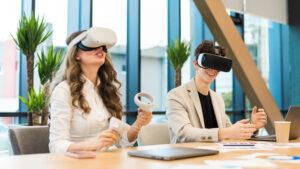
The retail and hospitality industries depend greatly on customer experience, service quality, and the efficiency of their staff. From assisting shoppers in retail stores to welcoming guests at hotel reception desks, employee performance directly impacts how customers perceive the service.
Traditional training methods like classroom sessions, printed manuals, and shadowing often fall short when preparing employees for real workplace situations. Even when staff understand the concepts, interacting with actual customers can still be difficult.
This is where Virtual Reality (VR) training is transforming the way businesses train their employees.
VR training gives retail and hospitality staff the chance to practice real customer service situations in a virtual setting, helping them sharpen their skills and handle customer situations more confidently.
What is VR Training for Retail & Hospitality?
VR training uses virtual reality technology to recreate realistic workplace environments such as retail stores, hotel front desks, restaurants, and customer service counters.
Staff put on a VR headset and step into a virtual world, where they can engage with simulated customers and practice different aspects of their job.
These training simulations may include:
- Assisting customers in retail stores
- Handling customer complaints
- Managing checkout or billing counters
- Hotel guest check-in and check-out processes
- Restaurant order handling and service procedures
- Safety and emergency response training
By engaging directly in realistic scenarios, employees pick up skills much faster than with traditional training methods.
Why Traditional Training Methods Are Not Enough
Retail and hospitality businesses often face several training challenges:
Limited Practical Experience: While employees can learn procedures in a classroom, they seldom have the chance to practice real-world situations before interacting with customers.
Inconsistent Training Across Locations: Companies with several stores or hotels often find it challenging to keep training consistent across all locations.
High Training Costs: Ongoing training sessions, instructors, and physical materials can quickly become costly over time.
Low Engagement: Traditional training sessions can feel dull and make it hard for employees to remember what they’ve learned.
VR training addresses these challenges by offering hands-on, engaging, and repeatable learning experiences.
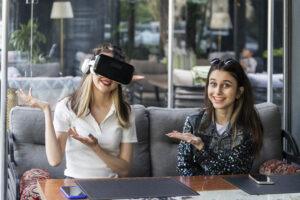
How VR Training Works
The VR training process for retail and hospitality staff is straightforward:
- Employees wear a VR headset connected to the training system.
- They enter a virtual store, hotel, or restaurant environment.
- The system presents realistic scenarios such as helping customers or resolving complaints.
- Employees interact with virtual characters and perform tasks.
- The system records performance and provides feedback.
By training in an immersive virtual environment, employees can repeat tasks freely, improving both their abilities and self-assurance safely.
Key Applications of VR Training in Retail & Hospitality
Retail Staff Training: Retail staff can use virtual simulations to practice helping customers, product recommendations, and store management.
Customer Service Training: Through virtual simulations, staff can experience a variety of customer interactions and learn how to handle them effectively.
Hotel Front Desk Training: Hospitality staff can use VR to practice welcoming guests, handling reservations, and addressing guest issues.
Restaurant Service Training: Restaurant staff can use VR to practice service procedures, streamline order handling, and improve customer interactions.
Safety and Emergency Training: Employees can use VR to practice responding to emergencies like fire evacuations or safety incidents.
Employee Onboarding: New employees can quickly get up to speed on workplace operations through immersive VR environments.
Benefits of VR Training for Retail & Hospitality Businesses
Faster Skill Development: Employees learn by doing, which improves training efficiency.
Better Customer Experience: Well-trained staff deliver higher-quality service to customers and guests.
Consistent Training Standards: VR training provides a consistent learning experience for employees across all locations.
Increased Employee Confidence: Employees feel prepared because they have already practiced real situations.
Reduced Training Costs: VR training can reduce the need for repeated physical training sessions.
Engaging Learning Experience: Hands-on virtual scenarios turn training into an enjoyable and memorable experience.
Growing Adoption of VR Training in India
Across India, many retail and hospitality businesses are turning to modern training solutions to enhance service quality.
Organizations in major Indian cities like Delhi, Mumbai, Bengaluru, Hyderabad, Chennai, Pune, Ahmedabad, Jaipur, and Kolkata are increasingly using VR training to enhance employee skills and boost customer satisfaction.
As businesses grow and customer expectations rise, immersive training is becoming a key tool for developing a skilled and confident workforce.
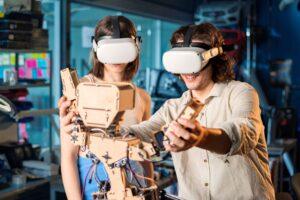
The Future of VR Training in Retail & Hospitality
VR technology is advancing quickly, and its use in employee training is set to expand. Future developments could include AI-driven virtual customers, real-time performance tracking, collaborative multi-user VR sessions, and seamless integration with corporate learning platforms. These innovations will make VR training more effective, engaging, and scalable for retail and hospitality businesses.
Retail and hospitality businesses thrive when employees deliver excellent service, but traditional training often falls short. VR training offers a practical solution, letting staff practice real-world scenarios in a safe, virtual environment. By using VR, businesses can train employees faster, enhance service quality, and create better customer experiences, making it a key part of the industry’s future.