
India is aging faster than its social infrastructure is prepared for. The demographic numbers are well documented — the proportion of Indians over sixty is growing consistently and will continue growing for decades. What the numbers do not fully capture is the daily lived reality that accompanies this demographic shift for millions of elderly people across the country. Nuclear families that have replaced joint families. Children who have moved to different cities or different countries for work. Retirement from professional and social roles that provided daily structure, purpose, and human contact. The gradual contraction of mobility that makes leaving home increasingly difficult. And the particular loneliness that comes from being surrounded by a busy world that is moving at a pace and through channels that feel increasingly foreign.
Loneliness in elderly populations is not a minor welfare concern. The clinical evidence linking chronic loneliness to accelerated cognitive decline, increased rates of depression, faster physical health deterioration, and significantly reduced life expectancy is substantial and consistent. This is a genuine public health issue that is going to grow significantly in scale over the coming decades as India’s elderly population expands.
A VR elderly social companion app addresses this directly—not as a technological novelty but as a genuine social infrastructure tool for a population that conventional digital platforms have largely failed to serve.
What the App Brings to the Table
The core function of a VR elderly social companion app is straightforward to state—it gives elderly people who are physically isolated genuine social presence with other people, meaningful shared experiences, and regular structured human contact through an immersive platform designed specifically for their needs rather than adapted from platforms designed for younger, more tech-comfortable users.
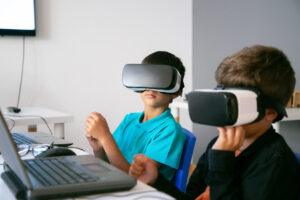
The user puts on a VR headset—ideally one that requires minimal technical setup, with large simple controls and a genuinely forgiving interface—and enters a virtual environment where they can spend time with other users in real time. Conversation. Shared activities. Familiar environments are recreated virtually—gardens, community spaces, religious settings, and places of personal significance. The social dimension is real even when the physical proximity is not.
The specific applications worth building around include:
- Virtual social gatherings where elderly users from different locations spend time together in a shared virtual space—the equivalent of a community sitting room or a social club meeting that geography and mobility no longer prevent
- Family connection experiences where elderly users share VR environments with family members who are geographically distant—not just a video call but a shared virtual space where grandparent and grandchild are genuinely in the same place doing something together
- Reminiscence therapy experiences where familiar environments from the user’s past—neighborhoods, homes, places of significance—are recreated in VR to support memory engagement and emotional well-being for users experiencing early cognitive decline
- Guided activity sessions—gentle exercise, creative activities, music listening, storytelling—conducted in shared virtual environments with a facilitator and a group of participants
- Religious and cultural participation for users whose mobility prevents physical attendance at places of worship or cultural events
Establishing Business Credibility
The commercial model for a VR elderly social companion service operates on multiple levels simultaneously.
Direct subscription from elderly users and their families is the most straightforward revenue stream—a monthly fee for access to the platform, the virtual environments, and the facilitated social programming. Family members paying for a parent or grandparent’s subscription are the most motivated buyers because the product addresses a genuine concern they carry about a person they love.
Institutional partnerships with elderly care homes, assisted living facilities, and retirement communities are the higher-volume commercial opportunity. A care home that provides VR social companion access to residents is offering a genuinely differentiating service that improves resident well-being, reduces staff burden associated with loneliness-driven distress, and gives the facility a meaningful point of distinction in a competitive market for high-quality elderly care.
Healthcare partnerships — hospitals, geriatric care specialists, and mental health services working with elderly populations — provide a clinical referral channel for users whose loneliness and isolation have genuine clinical dimensions. A geriatric psychiatrist who recommends a VR social companion program to patients experiencing depression associated with isolation is providing a clinically grounded referral that is different in kind from a general wellness recommendation.
Corporate CSR programs from companies with large retired employee populations represent a fourth revenue channel—organizations that genuinely care about the well-being of their retirees and have budget allocated to demonstrate that care.
The Deciding Design Factor
Most technology platforms designed for elderly users fail for the same reason—they are designed by young people who have thought about elderly users rather than designed with elderly users who have lived the experience the platform is trying to serve.
The interface needs to be genuinely simple in a way that does not feel condescending. Large visual elements, minimal required actions, forgiving error recovery, and a learning curve that feels gentle rather than steep. The headset hardware needs to be physically comfortable for users who may have limited neck mobility, reduced hand dexterity, or sensitivity to weight and pressure that younger users do not experience.
The social facilitation matters as much as the technology. Elderly users do not naturally form social connections in unstructured digital environments the way younger users do. Facilitated programming — scheduled activities, guided conversations, structured shared experiences — creates the social scaffolding that allows genuine connections to form. Hiring facilitators who understand how to create warm, inclusive, genuinely enjoyable social experiences for elderly participants is as important as getting the technology right.
How to Begin
The hardware for this service—VR headsets—can be rented from us for pilot programs with initial care home or community partners before committing to purchased equipment. Understanding which specific experiences and social formats resonate most strongly with your specific elderly user population before making significant equipment investments is genuinely valuable early-stage intelligence.
As your user base builds and your program reaches the session frequency that justifies ownership, purchasing your own fleet through us is the natural next step. We can advise on the headset configurations most appropriate for elderly user deployment—prioritizing comfort, simplicity, and reliability over the high-performance specifications that younger user applications prioritize.
A VR elderly social companion app built genuinely around the needs of its users—not a technology demonstration dressed up as social care—addresses one of the most significant and most underserved well-being needs in India’s aging population. The commercial opportunity is real. The social impact is real. The two are not in tension with each other.