
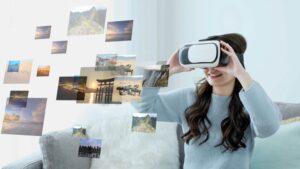
India’s tourism industry has a geography problem. The country’s most extraordinary destinations — the highest Himalayan passes, the most remote wildlife sanctuaries, the most fragile archaeological sites, the most inaccessible coastal landscapes — are accessible to a very small proportion of the people who would genuinely want to experience them. Cost, physical capability, time constraints, accessibility infrastructure, and in some cases genuine conservation limits on visitor numbers all create barriers between people and places they want to experience.
VR does not replace physical travel — nothing does and nothing should — but it opens access to experiences that physical travel cannot provide to most people and creates a category of immersive content that serves needs the conventional tourism industry has never been able to address.
What This Business Actually Creates
A VR tourism and travel experience business produces and deploys immersive destination experiences — using 360-degree video capture, drone footage, spatial audio, and in some cases 3D reconstruction — that allow people to experience places with a depth and presence that standard video or photography cannot replicate.
The DJI Mini 3 that we stock and rent is central to the content creation side of this business. Aerial footage captured with the Mini 3 creates the establishing shots and environmental context that gives VR destination experiences their sense of genuine place. The difference between a VR experience that opens with ground-level footage and one that opens with a Mini 3 aerial revealing the full landscape of a destination is the difference between seeing a place and feeling like you are arriving in it.
Combined with 360-degree ground-level capture at the destination — walking through a forest, standing at the edge of a viewpoint, moving through a heritage site — the aerial and ground footage together create an immersive experience that activates the brain’s presence response in ways that flat video simply cannot.

The Content Categories That Work Commercially
Heritage and Archaeological Sites
India’s heritage is extraordinary, and much of it is either deteriorating, crowded beyond comfortable visitor experience, or accessible only with significant logistical effort. A VR experience of Hampi, Ellora, or the Sundarbans created with genuine production quality can deliver the feeling of those places to people who will never visit them physically — and can deliver a version of the experience to people who have visited but want to explore more deeply than a standard tourist visit allows.
Heritage tourism VR content has a long commercial tail. A well-produced experience of a significant site remains commercially valuable for years rather than months.
Wildlife and Nature Experiences
Wildlife VR occupies a specific commercial space — it serves the enormous population of people who are genuinely interested in India’s extraordinary wildlife but who will never go on a jungle safari for reasons of cost, physical capability, time, or simply because the logistics feel too complicated.
A VR experience of Project Tiger reserves, of Kaziranga’s rhinos, of the Andaman reefs—produced with genuine quality using equipment we stock—creates content that tourism boards, wildlife organizations, schools, and direct consumers all have reasons to access and pay for.
Adventure Experiences
The adventure tourism market in India is growing but the experiences themselves — trekking at altitude, white water rafting, paragliding — are accessible only to people who are physically capable, financially able, and willing to accept genuine physical risk. VR adventure experiences serve the much larger population of people who are interested in the feeling of adventure but not in the physical reality of it.
These experiences are particularly compelling in a commercial context because the immersive physical sensation of altitude and exposure in a VR environment is genuinely impressive to first-time users in ways that create strong word of mouth.
Deployment Channels
The content you produce can be deployed through multiple channels simultaneously, creating revenue streams that work independently of each other.
These channels include a fixed venue — a VR tourism experience centre in a city or tourist destination — where customers pay to experience destination content, a mobile service that takes experiences to travel agencies, tourism offices, hotel lobbies, and travel expos where they function as both commercial experiences and marketing tools, and a content licensing model where tourism boards, hospitality companies, and travel agencies pay to access your content library for their own client-facing applications.
Tourism boards at state and national level are genuine potential clients for content that promotes their destinations. The marketing budget that currently goes to video production and print collateral increasingly has room for VR content that delivers a more compelling destination preview than any conventional marketing format.
Starting the Business
The content creation side requires equipment — specifically the DJI Mini 3 for aerial capture and 360-degree cameras for ground-level capture. Both can be rented from us for specific production trips in the early stages, with purchase decisions following the validation of your content business model.
The deployment side requires VR headsets—rented from us for specific events and presentations while your client base builds, purchased as deployment frequency reaches the point where ownership is financially smarter than ongoing rental.
The most financially efficient starting approach is to produce two or three genuinely excellent destination experiences — choose destinations that are well-known enough to have immediate audience recognition but interesting enough to offer something that casual video content does not—and use these as your demonstration library for every subsequent client conversation.
The Honest Commercial Reality
VR tourism content is not a fast business—production takes time and genuine effort, client relationships with tourism boards and hospitality companies develop on timelines that require patience, and the content licensing model takes time to build.
What makes the investment worthwhile is the longevity of the revenue. Quality destination VR content retains commercial value for years — a well-produced experience created now will still be generating revenue five years from now if the production quality is genuine and the distribution is well managed.
The businesses that invest in building a serious VR tourism content library now — during the period when the market is developing and the competition for that content is minimal — will find themselves in an extraordinarily strong position when the market matures and demand for quality destination VR content increases substantially.
India has more extraordinary destinations than almost any country on earth, and most of them have never been properly captured in VR.
That gap is the entire business — the destinations, the creativity, and the commercial relationships are yours to build around it.