
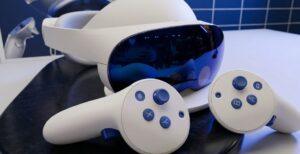
Most people who discover VR for the first time think about it as a consumer experience — something you try, enjoy, and move on from. What they miss completely is what VR actually is from a business perspective. It is a tool. A genuinely powerful, genuinely versatile tool that can be deployed across an extraordinary range of industries, applications, and customer needs in ways that create real businesses generating real revenue.
We rent and sell professional VR equipment — including the DJI Mini 3, GoPro HERO13 Black and a range of VR headsets and accessories. Everything in this guide can be started using equipment rented from us, purchased from us, or a combination of both depending on where you are in your business journey.
These are not theoretical ideas. They are genuine business models that people are building right now in Indian cities — and most of them are still early enough that whoever moves first in a given city has a real and meaningful head start.
1. VR Gaming Cafe
This is the most straightforward entry point and for good reason — it works.
Rent or purchase a fleet of VR headsets from us, find a good commercial space in your city, and create a venue where people pay per session to experience VR gaming in a social, well-managed environment. The model is simple, the demand is consistent, and in most Tier 2 and Tier 3 Indian cities the competition is essentially zero.
The business works because VR gaming is genuinely social. One person plays while the group watches, reacts, and waits for their turn. The atmosphere creates itself if the space is designed well and the equipment is reliable.
Starting with rented equipment from us makes particular sense here. You validate your local market, understand your customer base, and generate your first revenue before committing to the full purchase. Once you know the business works in your specific location, purchasing your own fleet through us becomes the financially obvious next step.
The cities where this works best are the ones where young people have awareness of VR from online content but no local access to try it. That description currently fits most Indian cities outside the major metros. The window to be first is still open in most of them.
2. VR Events and Entertainment Company
Rather than a fixed venue, you build a mobile operation — taking VR experiences to events, weddings, corporate gatherings, college festivals, and private occasions wherever clients need them.
The setup is essentially a portable VR arcade. Multiple headsets, a content library covering different experience categories, staff who can manage the equipment and guide participants through sessions, and the operational capability to set up, run, and pack down at any venue efficiently.
Renting equipment from us for specific events is the most financially intelligent starting point for this model. You do not carry the capital cost of owning a large headset fleet during the periods between events. You rent what you need for each booking, factor the rental cost into your event pricing, and purchase your own equipment as your booking volume reaches the level where ownership becomes cheaper than ongoing rental.
The corporate events market specifically is willing to pay well for genuinely novel entertainment experiences. A VR entertainment setup at a corporate annual party, a product launch, or a brand activation event commands fees that justify both the equipment cost and a healthy margin. Wedding entertainment is a growing market — VR gaming stations at receptions give guests something genuinely memorable to do and give the couple a talking point that their guests will remember years later.
3. VR Real Estate Marketing Service
Real estate developers and agents are increasingly aware that standard property photographs and floor plans are inadequate for selling high-value properties off-plan or remotely. VR changes this completely.
A business that creates VR property tours — immersive, walkthrough experiences of properties that allow potential buyers to experience the space before it is built or before they can physically visit — is providing genuine commercial value to real estate clients who have large marketing budgets and clear ROI metrics for what they spend on sales tools.
You need two things to build this business — the ability to create VR content, either through 360-degree video capture using equipment rented or purchased from us or through working with 3D modelling studios that create virtual property models, and the headsets to deploy these experiences at property sales offices, exhibitions, and client meetings.
The DJI Mini 3 rented or purchased from us captures the aerial footage that makes VR property tours genuinely compelling — showing the property in its neighbourhood context, the surrounding area, the approach and access. Combined with ground-level 360-degree interior capture you have a complete property VR experience that justifies genuine professional fees.
Real estate developers in Tier 1 and Tier 2 Indian cities are spending serious money on sales tools for new projects. A VR property tour business that approaches them with a professionally produced demonstration of what you can deliver will find receptive clients faster than most new service businesses.
4. VR Education and Training Centre
Schools, colleges, coaching institutes, and corporate training departments all have the same fundamental problem — explaining complex, abstract, or dangerous concepts through text and diagrams when direct experience would be significantly more effective.
VR solves this problem directly. Think of a chemistry lab where students can experiment without safety risks, a historical event that students can witness rather than read about, a machinery operation that workers can practice before touching real equipment, or a medical procedure that trainee doctors can rehearse hundreds of times in simulation before performing on a patient.
A VR education and training business that serves these markets can operate in multiple ways — as a fixed learning centre that institutions bring groups to, as a mobile service that takes equipment directly to schools, colleges, and corporate training facilities, or as a content development service that creates custom VR training experiences for specific institutional clients.
The equipment for this business can be rented from us for specific institutional bookings in the early stages, transitioning to owned equipment as the booking volume justifies the capital investment. A school that brings fifty students for a VR science session once a month is a predictable, recurring revenue relationship that quickly justifies equipment ownership.
The content side of this business is where genuine differentiation lives. Generic VR experiences demonstrate the technology but custom content aligned to specific curriculum requirements or specific corporate training needs commands premium fees and creates client relationships that competitors without that content cannot replicate.
5. VR Therapy and Wellness Centre
This one surprises people but it is genuinely well-evidenced commercially and clinically.
VR is being used effectively for phobia treatment — fear of heights, fear of flying, social anxiety — through controlled exposure therapy, as well as for pain management, stress reduction, mindfulness, rehabilitation following physical injuries, and autism spectrum support through social skills training.
A VR therapy and wellness centre does not require you to be a clinician. It requires you to partner with licensed therapists and psychologists who understand the clinical applications and can supervise the therapeutic use of the technology while you provide the technical infrastructure and the commercial operation.
The business model works through session fees charged at rates comparable to or slightly below conventional therapy — making it genuinely accessible while maintaining commercial viability. Corporate wellness partnerships where companies purchase access for their employees as part of mental health support programs provide a B2B revenue stream alongside individual client work.
Equipment rented from us for initial client sessions while validating the model, transitioning to purchased equipment as the client base and session volume grows, is the sensible financial sequence for this business. The headsets used for wellness applications need to be maintained to a high standard of cleanliness and reliability — something we can advise on when you rent from us.
6. VR Fitness Studio
Traditional gyms are struggling with retention. The dropout rate for gym memberships is well-documented and the core reason is consistent — exercise is perceived as boring, repetitive, and effortful without sufficient reward to maintain motivation.
VR fitness changes this dynamic directly. When the exercise is happening inside a boxing game, a dance experience, or a physically demanding adventure, the effort feels like play rather than work. The physical demands are real — a proper VR boxing session burns calories comparable to a conventional workout — but the psychological experience is completely different.
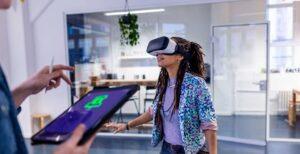
A VR fitness studio combines the equipment and space management of a conventional fitness facility with the content and experience of a gaming venue. The target demographic is people who want the benefits of physical fitness but genuinely dislike conventional exercise environments — a group that is large, underserved, and willing to pay premium prices for something that makes fitness feel like fun.
The equipment investment for a VR fitness studio — headsets, sufficient open space for physical movement, safety flooring, equipment management systems — can be started with rented headsets from us to validate the concept before the full purchase commitment. Understanding which VR fitness experiences your specific customer base responds to before buying a full fleet of headsets is genuinely valuable market research.
7. VR Tourism and Travel Experience Business
India’s tourism sector has a genuinely interesting VR opportunity that is almost entirely unexplored.
Destinations that are difficult to access — remote hill stations, wildlife sanctuaries, archaeological sites with limited visitor capacity — can be experienced virtually, heritage sites can be explored in their original state through VR reconstructions, and adventure experiences too physically demanding or expensive for most people can be made accessible through simulation.
A VR tourism business creates immersive destination experiences and sells access to them through tourism offices, travel agencies, hotels, and directly to consumers through a fixed venue or mobile events operation.
The content creation side of this business uses equipment that we stock — including the DJI Mini 3 for aerial capture that forms the backbone of genuinely immersive destination experiences. The deployment side uses VR headsets rented or purchased from us to run the experiences for paying customers.
Tourism boards and hospitality companies are increasingly willing to invest in VR content as a marketing and experience tool. A business that can create genuinely compelling destination VR content and deploy it effectively is simultaneously a content production business and an experience business — two revenue streams from the same core capability.
8. VR Architecture and Interior Design Visualisation
Architects and interior designers have a consistent and expensive problem — clients cannot accurately visualise what a designed space will look and feel like from two-dimensional plans and renderings. This leads to expensive changes after construction begins, client dissatisfaction with results that matched the specification but not the expectation, and the general friction of trying to communicate three-dimensional spatial experience through flat images.
VR solves this directly. A VR architectural visualisation service creates walkthrough experiences of designed spaces before a single brick is laid. Clients experience the actual scale, light, and spatial relationships of a proposed design in a way that no render or model can replicate. Changes are made in the digital model rather than the physical construction, saving time and money while preventing relationship damage.
A business providing this service needs 3D modelling capability — either in-house or through partnerships with architectural visualisation studios — and VR headsets for client presentation sessions. The headsets for client presentations can be rented from us for individual client meetings in the early stages, giving the business professional presentation capability without the overhead of owning equipment that may not be in constant use initially.
Architecture firms, interior design studios, real estate developers, and hospitality groups designing new hotel and restaurant spaces are all potential clients for this service. The fees are justified by the genuine value of preventing expensive mistakes and improving client satisfaction and referral rates.
9. VR Corporate Training Business
Every large company in India spends money on employee training. Most of that training is ineffective — classroom sessions that people sit through without genuine engagement, online modules that people click through as fast as possible to get the completion certificate.
VR training is measurably more effective than conventional training for a wide range of applications. Applications include customer service training where employees practice difficult conversations, safety training where workers rehearse emergency responses, leadership training where managers practice feedback and conflict resolution, and sales training where salespeople rehearse high-stakes presentations and negotiations.
A VR corporate training business develops training content for specific corporate applications and deploys it through either owned equipment at client sites or mobile deployment using equipment rented from us for specific training programs.
The corporate training market is large, the budgets are real, and the appetite for approaches that demonstrably work better than conventional training is genuine. A business that can show measurable improvement in training outcomes — through simulation performance metrics, assessment results before and after training, or real-world performance data — will find corporate clients who return for additional programs and refer to other departments and other companies.
10. VR Content Creation Agency
Every business on this list needs VR content — experiences, games, simulations, tours, training programs. Creating that content is a skill that is currently in short supply relative to the growing demand for it.
A VR content creation agency that produces professional VR experiences for the full range of commercial applications — real estate tours, corporate training, educational programs, entertainment experiences, retail and marketing activations — is a service business that benefits from every other VR business expanding.
The equipment side of this business — 360-degree cameras, drones for aerial capture, VR headsets for testing and quality assurance — can be rented from us for specific production projects in the early stages, with owned equipment purchased as project volume justifies the investment.
The DJI Mini 3 specifically is central to high-quality VR content production. Aerial footage captured with the Mini 3 creates the establishing shots and environmental context that makes VR experiences genuinely immersive rather than spatially disorienting. A content production company that can deliver complete VR experiences — aerial, ground-level, and digitally created elements combined — has a genuinely complete offering that individual freelancers cannot match.
11. VR Retail and Brand Experience Agency
Brands are looking for ways to create genuinely memorable customer experiences that go beyond conventional retail and advertising. VR provides exactly this.
A VR brand experience agency creates immersive brand experiences for retail environments, trade shows, product launches, and marketing activations. Examples include a car manufacturer letting customers virtually experience driving a new model before test drives are available, a travel brand letting customers visit destinations virtually before booking, and a food brand creating an immersive farm-to-product journey that builds genuine consumer connection with the product.
These experiences are produced using equipment we stock and deployed on headsets rented from us for specific activations — the mobile rental model works perfectly for brand experiences that run for a defined campaign period rather than permanently.
Brand activation budgets at major companies are substantial. A VR experience that generates genuine social media sharing — which VR experiences reliably do because people want to share genuinely extraordinary things — delivers marketing value that justifies the investment and creates the measurable ROI that brand managers need to justify the spend internally.
12. VR Sports Training Academy
Elite sports coaching has used video analysis for decades. VR takes this to a genuinely different level — athletes can practice scenarios, study opponents’ movements, and rehearse decision-making in immersive simulations that conventional training methods cannot replicate.
Cricket batters can face specific bowling styles, football goalkeepers can practice penalty saves against different takers, and badminton players can study opponent shot patterns. The applications across Indian sports are genuinely extensive.
A VR sports training academy pairs VR simulation with conventional coaching to create a training offering that is more effective than either alone. The technology side uses equipment rented or purchased from us. The coaching side requires genuine sports expertise and relationships with athletes, academies, and sports organisations.
This business works at multiple levels simultaneously — individual athlete training, team training programs, sports academy partnerships, and corporate sports day and team building events that use sports VR experiences for entertainment rather than serious training.
The Key Connecting Insight
Every business on this list has the same foundation — VR equipment that you can rent or purchase from us, deployed with genuine skill and genuine commitment to the customer experience.
The equipment is the starting point, not the ending point. What you build around it — the customer relationships, the content, the operational systems, the reputation — that is what actually creates a business worth having. We are here for the equipment part of that journey. Every stage of it.
Whether you are renting for your first event to validate the concept, purchasing your first fleet after validating the market, scaling to multiple locations, or upgrading to more capable equipment as your business matures — we stock what you need, we understand how it is used professionally, and we can advise on what genuinely serves your specific business rather than what simply looks impressive on a spec sheet.
The opportunities listed here are real. The markets for them are growing. The competition in most Indian cities for most of these ideas is genuinely thin right now.