
Of all twelve business ideas built around VR equipment, the gaming cafe is the one that gets dismissed most quickly by people who think they are being sophisticated. It sounds too simple. Too obvious. Too much like something that has already been done.
Those people are wrong, and the market data in Indian cities right now proves it.
Most Indian cities outside the major metros have either zero VR gaming cafes or one poorly run operation that gives the entire concept a bad reputation rather than building it. The demand exists. The awareness exists. The local supply of genuinely well-executed VR gaming experiences does not. That gap is the whole business case, and it is sitting open in hundreds of cities across the country right now.
What a Properly Run VR Gaming Cafe Actually Looks Like
The version of this business that fails is the one that treats VR as the product. Buy some headsets, find a cheap space, charge people to use them, hope for the best. This version exists in some cities already and it looks like exactly what it is — a technology demonstration rather than a business.
The version that succeeds treats experience as the product and VR as the delivery mechanism. The distinction sounds subtle but it changes every single decision you make.
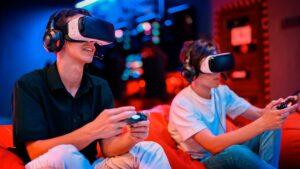
A properly run VR gaming cafe is a social space first. The layout, the lighting, the seating, the atmosphere — all of it is designed around the reality that most customers arrive in groups of two to six people and the entire group needs to have a good time regardless of who is currently wearing the headset. The person playing is having one experience. The people watching — seeing their friend react to something invisible, laughing at their movements, waiting for their turn — are having a parallel experience that is equally entertaining when the space is designed correctly.
Screens showing the player’s first-person perspective are not optional extras. They are what transforms a waiting experience into a watching experience. When the group can see what the player sees, the entire room is inside the game together even if only one person has the headset on.
Starting With Rented Equipment Makes Genuine Financial Sense
Here is something most business guides will not tell you because most business guides are written by people who have never actually started a business.
Buying your full equipment fleet before validating your specific local market is a financial risk that is entirely avoidable.
Rent from us first. Take four headsets for a weekend, find a temporary space, charge a small group of friends and acquaintances a nominal fee, and run actual sessions. Watch what happens — which games generate the most excitement, how long people naturally want to stay, what questions first-timers ask before they feel comfortable putting the headset on, and what the energy in the room feels like when a session is going well.
That information — collected from real experience rather than projected from research — is worth more than any market analysis you could commission. It tells you specifically what your local customer base responds to rather than what customers in general are supposed to respond to.
Once you have validated the concept with rented equipment, the purchase decision becomes straightforward rather than speculative. You are buying equipment for a business you have already proven works in your specific location rather than hoping it will work based on what worked somewhere else.
We sell and rent VR equipment including everything you need to run a professional gaming cafe operation. The transition from renting to buying is a conversation we have with operators regularly and we can advise on the timing that makes financial sense for your specific situation.
The Location and Setup Decisions That Actually Matter
Location selection for a VR gaming cafe is not about finding the cheapest available space. It is about finding the space where your target customers already are.
Areas near colleges and universities are the most reliable starting points. Students socialise in groups, make plans spontaneously, and have the social energy that makes a VR cafe feel alive rather than empty. An empty VR cafe is its own worst marketing — visible inactivity signals to passersby that nothing worth doing is happening inside.
Commercial areas with consistent evening foot traffic work for the same reason. The evening window — roughly six to ten PM in most Indian cities — is when young people are out and looking for somewhere worth spending time. Position yourself where they already are rather than expecting them to travel specifically to find you.
The space itself needs open floor area for players to move around without hitting anything or anyone. Ceiling height matters more than most people realise — low ceilings create a cramped feeling that undermines the immersive quality of the experience. Good air conditioning is non-negotiable because VR headsets generate heat and players generate more.
The Game Library Decisions That Drive Return Visits
First-time visitors will come out of curiosity. Return visits are driven entirely by the quality and variety of what you offer.
Build your game library around social experiences rather than solo ones. Multiplayer games where two to four players compete or cooperate simultaneously create the shared energy that drives word of mouth. Single-player experiences — even extraordinarily impressive ones — do not generate the group dynamics that make people want to come back with different friends.
Refresh your content regularly. Quarterly additions to the game library give regular customers something new to return for. A customer who has played everything in your library has no reason to come back. A customer who knows something new arrives every few months has a standing reason to keep visiting.
Pricing That Reflects Genuine Value
Price this business at what it is actually worth. Not at what feels safe or what you imagine people will accept without pushback.
A properly run VR gaming session—good equipment, clean space, well-managed experience, and genuinely entertaining content—is worth two hundred and fifty to six hundred rupees per person per session in most Indian Tier 2 cities. More in metros. The customers who push back on this pricing are usually not your real customers anyway.
Underpricing signals low quality before the customer has experienced anything, attracts the most demanding and least loyal customers, and makes the financial model genuinely difficult to sustain even when the venue is busy.
Group packages make sense. Four people booking together should get a slightly better per-person rate than four individuals booking separately — not because you need to discount, but because removing friction from the group booking decision fills your sessions more reliably.
Word of Mouth Is Your Real Marketing Budget
A VR gaming cafe markets itself when it is run properly. The reactions — genuine, unfiltered, often dramatic — that people have during VR sessions are among the most shareable content that exists on social media right now. People post videos of their friends playing VR because the content is genuinely entertaining to watch.
Encourage this actively. Create a policy that filming is welcome. Set up a dedicated filming spot where friends can capture their group’s reactions cleanly. The social media content generated by your customers in a single weekend will reach more potential customers than a month of paid advertising.
The Core Business Insight
A VR gaming cafe is not a complicated business. It is not technically demanding to operate. It does not require industry experience or specialist background.
What it requires is genuine commitment to the customer experience, reliable, well-maintained equipment, a space designed for groups rather than individuals, pricing that reflects real value, and the patience to build word of mouth rather than expecting overnight success.