

There is something genuinely smart about this business model that the fixed-venue version of VR entertainment cannot replicate.
A VR gaming cafe waits for customers to find it. A VR events and entertainment company goes directly to where customers already are — weddings, corporate gatherings, college festivals, brand activations, private parties, and public events — and delivers the experience in their environment rather than expecting them to travel to yours.
That difference in positioning changes the entire commercial logic of the business. Your revenue is not dependent on foot traffic to a fixed location. Your customer acquisition cost is essentially zero for event bookings because the event organiser is paying you to be there. Your geographic reach also extends as far as you are willing to travel rather than being limited to the catchment area of a single venue.
What This Business Actually Is
Strip it down to its simplest form and a VR events and entertainment company is a mobile VR arcade operated by people who know how to set it up, run it professionally, and pack it down efficiently at any venue.
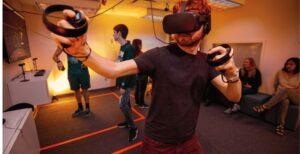
It consists of multiple headsets, a content library covering different experience categories — gaming, experiences, simulations, social content — that can be matched to different event types and demographics, and staff who can manage the equipment, guide participants through sessions, and create the kind of enthusiastic, well-managed atmosphere that makes VR genuinely entertaining rather than just technically impressive.
The business also requires the logistical capability to arrive at a venue, set up a fully operational VR entertainment station in under two hours, run sessions continuously for four to six hours, and leave without a trace.
That last capability — clean, efficient, professional setup and breakdown — is what separates operators that get repeat bookings and referrals from operators that get one booking and a polite decline when they follow up.
The Markets Worth Focusing On
Corporate Events
This is the highest-value market available to a VR events company and it deserves the most deliberate attention.
Companies spend serious money on annual parties, team building days, product launches, client entertainment events, and brand activations. The people making decisions about what entertainment to book at these events have real budgets and genuine pressure to book something that impresses rather than something that is merely adequate.
VR entertainment at a corporate event does something that a DJ, a photo booth, or a conventional games area cannot do — it creates genuine conversations. Colleagues who would otherwise stand in separate groups with their drinks end up in the same space, watching each other’s reactions, competing for scores, laughing together in ways that only shared novel experiences create. HR managers who book team building activities are looking for exactly this outcome.
The fees for corporate event bookings reflect this value. A four-hour VR entertainment station at a corporate event in an Indian Tier 2 city commands fees in the range of thirty to eighty thousand rupees depending on the headset count, the content package, and the specific nature of the event. Metro city corporate events command significantly more.
Weddings
The Indian wedding entertainment market is enormous and weddings are genuinely competitive environments where families are constantly looking for the next thing that will make their celebration memorable and distinctive.
VR gaming stations at wedding receptions give guests something genuinely engaging to do during the periods between formal events — the gap between the ceremony and the dinner, the time between dinner and the dancing, the late hours when energy needs sustaining. Rather than standing around waiting for the next scheduled item, guests are playing, competing, and generating the kind of spontaneous social energy that makes celebrations feel genuinely alive.
Wedding planners who book VR entertainment for one event and see the positive response it generates become reliable referral sources. One strong relationship with an active wedding planner in your city is worth more than most advertising budgets.
College Festivals
College fests run on limited budgets but generate enormous footfall and word of mouth reach. A VR entertainment setup at a well-attended college festival introduces your business to hundreds or thousands of potential future customers in a single day.
The commercial model for college events is different from corporate — lower fees, sometimes structured as revenue sharing rather than fixed fee, but with disproportionate marketing value. The students who experience VR at a college fest become the word of mouth network that fills your future bookings.
Approach college fest organising committees three to four months before the event date. They plan well in advance and the good slots go to vendors who approach early with a clear, professional proposal rather than last-minute scrambling.
Brand Activations
Marketing agencies and brand teams are increasingly looking for experiential marketing solutions — physical activations that create genuine consumer engagement rather than passive advertising exposure. VR fits this need almost perfectly.
A brand that places customers inside a VR experience — a car brand that lets potential buyers virtually drive the new model, a travel brand that lets customers virtually experience a destination before booking, a food brand that creates an immersive farm-to-table journey — creates a memory and an emotional connection that a billboard or a digital ad cannot replicate.
Brand activation projects typically come through marketing agencies rather than directly from brand clients. Building relationships with event marketing agencies in your city opens access to brand activation budgets that are significantly larger than most event entertainment budgets.
Starting With Rented Equipment — Why It Makes Sense Here
The events model is particularly well-suited to starting with rented equipment from us and here is the specific reason why.
Your equipment needs for each event vary based on the event size, the duration, and the specific experiences being requested. A small private party might need four headsets, a large corporate annual event might need eight to twelve, and a brand activation running over three days at a major venue might need a different headset configuration entirely.
Owning a fixed fleet of equipment means either owning too much for small events — carrying capital cost on idle equipment — or owning too little for large events — turning down bookings or delivering an under-resourced experience.
Renting from us scales your equipment to each specific booking. You rent exactly what you need for exactly the duration you need it. The rental cost goes directly into your event pricing as a line item. The financial model is clean — every booking is profitable rather than some bookings subsidising idle equipment between bookings.
As your booking volume reaches the point where the cumulative rental cost exceeds the purchase cost over a defined period — and we can help you calculate exactly when that crossover point arrives for your specific booking pattern — purchasing your own base fleet becomes the financially obvious decision. You continue renting from us for the overflow bookings that exceed your owned fleet capacity.
This is not a compromise model. It is the financially intelligent sequence for building an events business of this type.
The Operational Capability That Actually Matters
The difference between a VR events company that gets repeat bookings and one that gets one chance and loses it is almost entirely operational.
Clients booking entertainment for significant events are trusting you with a piece of their event that their guests will remember. The fear of something going wrong — equipment that does not work, staff who cannot manage the technology under pressure, setup that runs over time and disrupts the event schedule — is what makes event organisers conservative about trying new vendors.
Remove that fear through demonstrable operational competence.
Arrive earlier than required — not just on time, but genuinely early. Complete equipment checks before a single guest arrives, and ensure staff are fully briefed on the specific event format, guest demographic, and any requirements from the event organiser.
A technical problem during an event is not a disaster if your response is fast, calm, and competent. Every piece of equipment should have a backup. Every session should have staff attention. Every participant should feel looked after rather than left to figure out unfamiliar technology alone.
The event organisers who become your most reliable repeat clients and your most enthusiastic referral sources are almost always won through exactly this kind of operational reliability rather than through having the most impressive headsets or the largest content library.
Building the Referral Network That Grows the Business
An events company that relies on finding new clients for every booking is working significantly harder than it needs to.
The goal is a referral network — wedding planners, corporate event managers, marketing agencies, college fest committees, hospitality venues — that generates a consistent flow of bookings without requiring you to source each one individually.
Every event you do well is an opportunity to expand this network. Give event organisers a specific reason to refer you — a referral fee for bookings that come through their recommendation, a priority booking arrangement that gives their clients preferred access to your calendar, or simply the confidence that you will make them look good in front of their own clients.
A referral network of twenty active event organisers across different event categories is more valuable and more stable than any amount of direct marketing. Build it deliberately rather than hoping it develops on its own.
The Financial Picture
An events business has genuinely attractive financial characteristics compared to a fixed venue operation.
The fixed overhead is lower — no permanent space rental, no fixed utility costs, no staff costs for days when no events are running — and revenue comes in event-sized chunks rather than session-by-session accumulation.
The challenge is revenue predictability. Events are not evenly distributed across the year. Wedding season peaks, corporate events cluster around certain calendar periods, college festivals follow the academic calendar. Cash flow management across the uneven revenue pattern requires planning and discipline.
Maintain a clear forward booking pipeline. Know what is confirmed, what is in negotiation, and what is prospective three months out at all times. The businesses that run into cash flow problems in this model are almost always the ones that are optimistic rather than realistic about their forward pipeline.
The Honest Reality
A VR events and entertainment company is genuinely buildable from almost any starting point. The capital requirement to begin is lower than almost any other VR business model because the equipment rental option means you can start generating revenue before making any significant capital commitment.
What it requires in return is genuine operational discipline, consistent professional standards at every event regardless of size, and the patience to build the referral network that creates genuine business stability rather than chasing individual bookings one at a time.
We have the equipment for every event size, every duration, and every content requirement.