
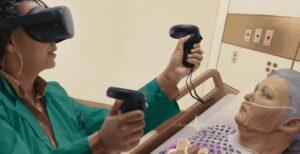
Healthcare training has always required a strong balance between theoretical learning and practical experience. Medical professionals such as doctors and nurses need to understand complex procedures, make quick decisions, and handle critical situations where accuracy and skill are essential.
Today, Virtual Reality (VR) is transforming the way healthcare professionals learn and practice their medical skills. Through immersive simulations of real clinical environments, VR enables doctors and healthcare staff to gain practical experience while ensuring patient safety.
What is VR training in healthcare?
Virtual reality training in healthcare uses immersive digital environments that simulate hospitals, operating rooms, and patient care scenarios. Using VR headsets and interactive software, healthcare professionals can participate in realistic training exercises that replicate real medical situations.
Rather than relying only on textbooks or classroom lectures, trainees can step into virtual real-world scenarios where they practice and build practical skills in a safe, controlled environment.
Many hospitals, medical schools, and healthcare organizations are now adopting this technology to improve training methods and deliver better patient care.
How VR Training Works for Healthcare Providers
Most VR healthcare training systems are built around three key elements: hardware devices, simulation software, and tools that track and analyze performance.
1. VR Headsets and Equipment
Healthcare professionals use VR headsets to enter realistic 3D environments, such as operating rooms or emergency units, where motion tracking lets them move and interact naturally within the simulation.
2. Medical Simulation Software
VR training platforms offer simulations that mirror real medical procedures and patient interactions, allowing users to practice diagnosing conditions , and emergency care without real-world risk.
3. Performance Tracking and Feedback
VR systems track user performance by recording factors such as decision-making, response time, and procedural accuracy and how accurately they perform procedures, helping trainers assess skill development.
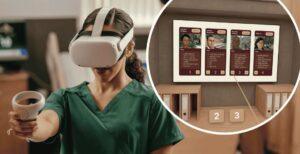
Real-World Use Cases of VR Training in Healthcare
Surgical Training
Virtual Reality enables surgeons and medical students to rehearse complex procedures in a simulated operating room, helping them build precision and confidence before working with real patients.
Emergency Response Training
Hospitals use VR simulations to recreate emergency scenarios like trauma cases, cardiac arrests, and mass casualty incidents, allowing healthcare teams to train for rapid and coordinated responses.
Patient Interaction Training
VR simulations give healthcare professionals the chance to practice patient communication and care scenarios with patients, leading to more empathetic and patient-focused care.
Medical Equipment Training
Through virtual simulations, medical staff can learn how to use complex medical equipment without the risk of damaging costly machines.
Infection Control and Safety Training
VR can recreate hospital settings where healthcare workers practice proper hygiene, wearing protective gear correctly, and preventing the spread of infections.
Key Benefits of VR Training for Healthcare
Safer Learning Environment
VR allows healthcare professionals to practice procedures without risking patient safety.
Improved Skill Retention
Studies show that immersive learning improves knowledge retention compared to traditional learning methods.
Realistic Medical Simulations
VR creates highly detailed simulations that replicate real hospital environments and medical procedures.
Cost-Effective Training
Hospitals can reduce costs associated with physical training equipment, setup, and repeated practice sessions.
Scalable Training Programs
VR allows organizations to train multiple healthcare professionals efficiently and consistently.
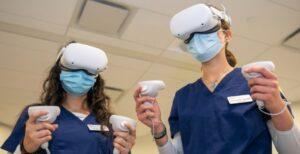
Why Healthcare Institutions Are Adopting VR Training
Healthcare organizations around the world are increasingly adopting Virtual Reality for training because it offers a more engaging and practical learning experience. Unlike traditional classroom methods that focus mainly on theory, VR allows healthcare professionals to practice realistic medical scenarios in a safe virtual environment. This hands-on approach helps trainees repeat procedures, strengthen their skills, and build confidence. As technology continues to advance, VR training is becoming an essential part of modern medical education and workforce development.
The Future of VR in Healthcare Training
The future of virtual reality in healthcare is very promising as technology continues to improve and simulations become more realistic and interactive. In the coming years, VR is expected to play a bigger role in medical education, surgical training, remote learning programs, hospital staff development, and healthcare research. By adopting VR training early, healthcare organizations can better prepare their staff, improve patient safety, and stay ahead in the rapidly evolving field of medical education technology.
Virtual reality is transforming the way healthcare professionals acquire and refine their medical skills. By providing immersive, safe, and interactive training experiences, VR enables medical staff to practice real-world scenarios with confidence and precision. As hospitals and medical institutions increasingly embrace advanced technologies, VR is set to become a vital tool for improving healthcare education, boosting clinical performance, and ultimately delivering higher-quality patient care.