
There is a fundamental problem with how education and training work in India right now that nobody in the system wants to say out loud.
Students sit through classes, take notes, pass examinations, and retain a fraction of what they were supposed to learn. Corporate employees complete mandatory training modules by clicking through slides as fast as the system allows and remember almost nothing by the following Monday. The knowledge transfer that education and training are supposed to deliver is happening at a fraction of its potential effectiveness because the delivery mechanism — passive consumption of information presented on flat surfaces — is fundamentally mismatched with how human brains actually absorb and retain complex concepts.
VR does not fix this problem by making the same content more entertaining — it fixes it by replacing passive consumption with active experience, and that distinction changes everything about learning outcomes.
What This Business Actually Delivers
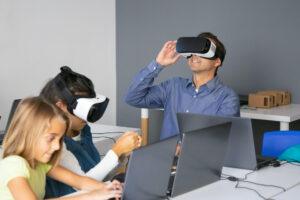
A VR education and training centre creates immersive learning experiences that put students and trainees inside the subject matter rather than in front of it.
A medical student does not read about surgery — they perform it in simulation, making decisions and observing consequences in real time. A chemistry student conducts reactions themselves in a virtual lab where mistakes have no physical consequences but genuine learning value. A history student stands on the field where a battle happened and understands the geography, scale, and human reality of it in ways no textbook description can replicate.
A corporate safety trainee does not watch a video about fire evacuation procedures — they experience the emergency in a simulated environment that activates the same responses as a real one, building genuine muscle memory for a situation where muscle memory could save their life.
The difference between reading about something and experiencing it is not incremental — it is categorical. VR delivers the experiential side of that gap in a controlled, safe, repeatable environment that no other technology can match.
The Markets Available to This Business
Schools and Colleges
Educational institutions at every level are looking for ways to improve learning outcomes, reduce the gap between curriculum and comprehension, and prepare students for a world that increasingly demands practical capability rather than theoretical knowledge.
The subjects that benefit most immediately from VR learning experiences are science — particularly chemistry, biology, and physics where hands-on experimentation is dangerous, expensive, or impractical at scale — along with history and geography where spatial understanding dramatically improves comprehension, and vocational subjects where practical skill development is the entire point.
A VR education centre that develops curriculum-aligned experiences for specific subjects and makes them available to schools through either group visits to your facility or mobile deployment to school premises has a genuinely scalable business model. One well-developed chemistry lab experience can be sold to every chemistry-teaching institution in your region.
Corporate Training
Every large organisation in India spends money on employee training and the majority of that spending delivers inadequate returns because the training itself is inadequately designed and delivered.
Safety training is the most immediately compelling corporate application. Industries with genuine physical safety requirements — manufacturing, construction, chemical processing, oil and gas, healthcare — have both regulatory obligations to train their workforces and genuine financial and human cost consequences when training is inadequate. A VR safety training program that demonstrably improves emergency response capability is not a nice-to-have for these organisations — it is a business necessity.
Customer service training, leadership development, compliance training, and onboarding programs all have genuine VR applications that deliver measurably better outcomes than classroom equivalents. The corporate training market has real budgets, clear decision-making processes, and an increasing appetite for approaches that work rather than approaches that simply fulfil compliance requirements.
Coaching Institutes
India’s coaching institute sector is one of the most intense educational environments in the world and it is also one of the most pedagogically conservative. The pressure on students is extraordinary. The pressure on institutes to improve their results is equally extraordinary. VR learning experiences that demonstrably improve comprehension and retention for competitive exam subjects have a compelling value proposition for institutes that are measured entirely on their students’ results.

Operating Models
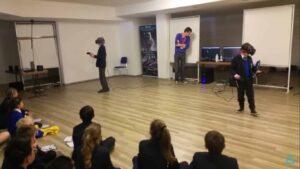
A fixed VR learning centre that institutions bring student groups to for scheduled immersive sessions works well in cities where multiple educational institutions are within reasonable travel distance. The centre becomes a shared educational infrastructure that individual institutions could not justify owning independently.
A mobile service that takes equipment directly to schools, colleges, and corporate training facilities removes the travel barrier and opens access to institutions that cannot easily send large student groups to an external venue. The operational complexity is higher but the addressable market is significantly larger.
A content development service that creates custom VR training experiences for specific institutional clients — a corporate safety training program built specifically for a manufacturing company’s actual facility, a history program built around a specific curriculum — commands premium fees and creates client relationships that no competitor without that specific content can step into.
The most sustainable business model combines all three — a fixed centre generating consistent base revenue, a mobile service extending geographic reach, and a content development capability creating the proprietary assets that differentiate the business long-term.
Equipment and Getting Started
The equipment for this business can be rented from us for specific institutional bookings in the early stages. A school that wants to experience one VR science session before committing to a regular program does not require you to own a full headset fleet before you have validated the relationship.
As booking volume builds — and a school that brings fifty students monthly quickly justifies equipment ownership economically — purchasing your own fleet through us becomes the financially intelligent next step. We can help you calculate the crossover point for your specific booking pattern and advise on the headset configuration that best serves the educational applications you are running.
The Content Side Is Where the Business Is Won
Generic VR experiences that demonstrate the technology without genuine curriculum alignment will generate initial interest and little repeat business. Educational institutions are not paying for impressive technology demonstrations. They are paying for learning outcomes.
Custom content aligned to specific curriculum requirements, specific skill development objectives, or specific corporate training needs is what creates genuine client loyalty. An institution that has paid for a VR experience built around their exact syllabus requirements has no reason to look elsewhere. The content itself is the lock-in.
Build your content library deliberately. Start with the subjects and training categories where VR delivers the most obvious and measurable learning improvement — science labs, safety training, medical procedures, historical immersion. Develop those experiences to a genuinely high standard before expanding into other categories.
The Honest Business Case
VR education is not a speculative future market. It is a present market with real institutional buyers, real budgets, and real frustration with the inadequacy of current training and education delivery.
The businesses that enter this market early with genuine educational quality — not impressive technology dressed up as education but actual learning experiences that deliver actual outcomes — will build institutional relationships that compound in value as VR becomes standard educational infrastructure rather than novel supplementary technology.
That transition is happening. The question is whether you are building a business during it or watching from the outside while it happens. We have the equipment to get you started — the content and the relationships are yours to build.